Garage Door Repair Gold Coast

Panel and section faults

Sectional & Panel-Lift Door Repairs

Sectional and panel-lift doors are built from hinged horizontal sections. When one section is damaged or out of line, the question is usually whether a single panel can be replaced or whether the whole door has moved on.

This page covers panel damage, hinge and strut faults, seals and alignment, and the matching problem that makes single-panel replacement harder than it sounds.

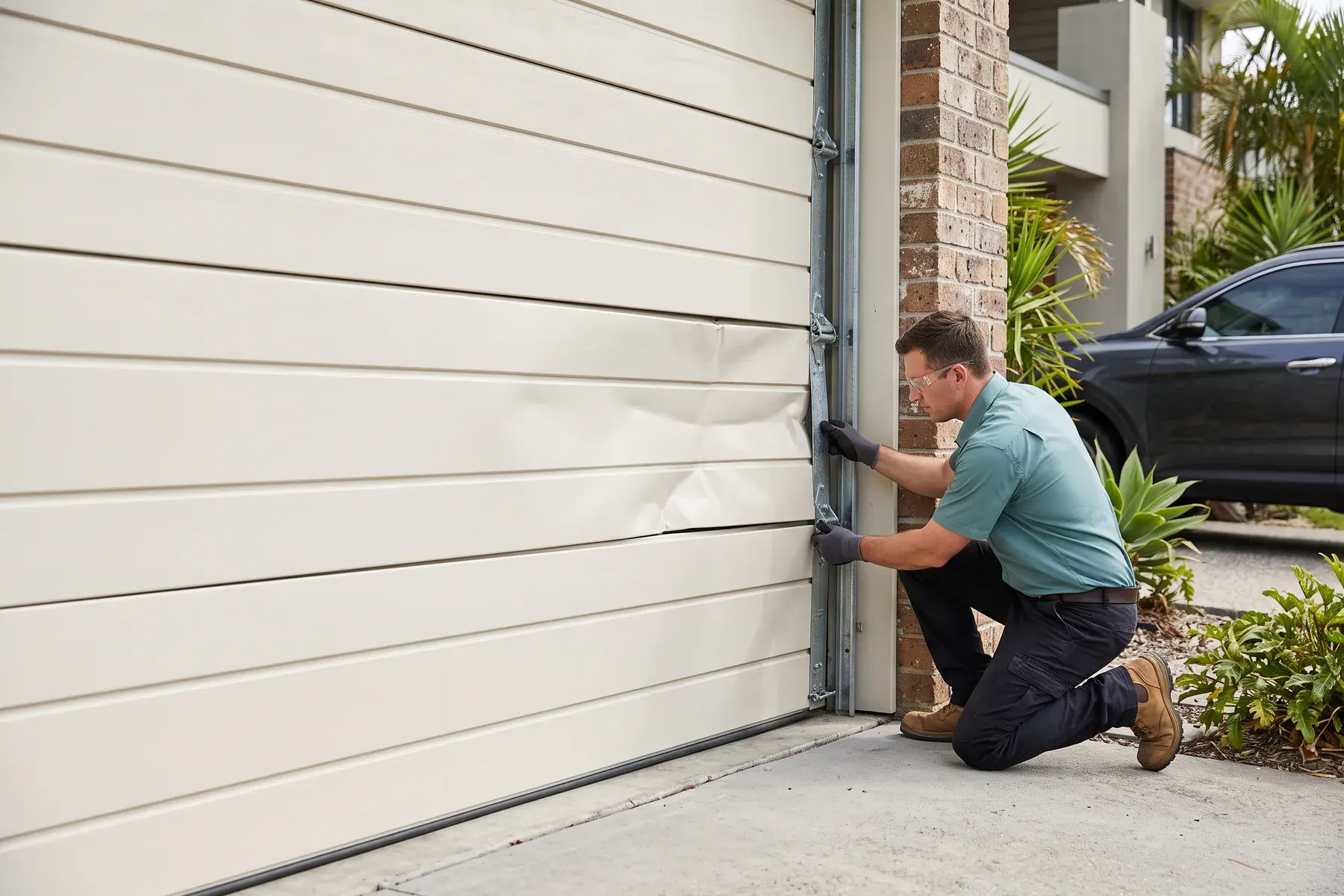
Illustrative sectional & panel-lift door repairs assessment
  • Panel, hinge, strut and seal assessment
  • Colour and profile matching confirmed on site
  • No installation or new-door supply claimed here

The problem

What makes sectional doors different

A sectional door is several rigid horizontal sections joined by hinges. That construction is what lets the door travel from vertical to horizontal through the track radius, and it is also why panel damage behaves differently here than on a roller door.

Because the sections are separate, a single damaged panel can sometimes be replaced without touching the rest of the door. Because they are joined and must stay in plane, a single damaged panel also puts every neighbouring hinge, roller and cable slightly out of alignment until it is dealt with.

The complication is matching. Panel profile, rib pattern, surface texture and colour all have to match closely enough to look right and fit the existing hardware. On a door of any age this is the factor that most often decides whether a repair is realistic.
How it works

The parts of a sectional door

Being able to name the section and the hardware makes the assessment conversation far more precise.

Sections and panels
Usually four or five horizontal sections. The bottom section carries the bottom brackets and the floor seal and takes most impact damage.
Hinges
Numbered by position across the door. They join sections and carry the intermediate rollers. Cracked or elongated hinges let sections shift.
Struts
Horizontal reinforcing bars fitted across wider sections to stop them bowing. A missing or bent strut shows as a section flexing under load.
Seals
The bottom seal against the floor plus perimeter weather seals. They control water, dust and vermin rather than door operation.
Top and end rollers
Positioned to hold the top section against the header and to keep the door in plane at the outer edges.
Finish
Powder-coated or pre-finished steel in a colour and profile that determines whether a replacement panel can be matched.

Fault groups

Common sectional door faults

Most panel-lift enquiries fall into one of these.

Impact damage to the bottom section

What you notice: A crease or dent from a vehicle, bin or bike; the door may still run but sits differently.

The bottom section is the most commonly damaged and the most consequential, because it carries the bottom brackets.

Cracked or pulled hinges

What you notice: A gap opening between two sections; a rattle under load; a roller sitting at an angle.

Frequently the first visible sign that the door has been running out of alignment.

Bowing section

What you notice: A wide section flexing noticeably as the door lifts.

Often a missing, damaged or incorrectly fitted strut.

Perished or damaged seals

What you notice: Water tracking under the door, daylight at the edges, wind noise.

A comfort and weather issue rather than a safety one, but common in exposed coastal positions.

Sections out of plane

What you notice: The door does not sit flush in the opening; one edge stands proud when closed.

Usually points at hinges, rollers or track alignment rather than the panels themselves.

Corrosion at fixings and section edges

What you notice: Staining around hinge fixings, blistering paint along a section edge.

More common where the door faces prevailing salt-laden weather.

Safety boundary

Where the safe boundary sits

Panel work sits close to the counterbalance and the bottom brackets, which is why it is an assessment rather than a DIY task.

If someone is injured, or there is a fire or electrical emergency, call 000 first.

Do this while you wait

  • Stop using a door with a section that has visibly moved out of plane.
  • Photograph impact damage before anything is moved, especially if an insurer may be involved.
  • Note whether the door still runs and whether it now catches anywhere.
  • Keep vehicles clear of the door until alignment has been checked.

Do not attempt

  • Do not remove hinges or fixings from a door that is not fully supported.
  • Do not touch the bottom brackets — they are under cable tension with the door closed.
  • Do not attempt to bend a creased section back into shape.
  • Do not keep operating a door where a section is visibly flexing.
  • Do not assume a replacement panel will match — that is confirmed by inspection.

Symptom check

Matching symptoms to a safe next step

Observed behaviour only. A provider confirms the cause in person.

Observed behaviour only. A garage door cannot be diagnosed remotely, and the same symptom can have more than one cause.
What the door does What you hear What you can see Safe next step
Use with care Door runs but a section sits proud A knock as it passes the radius A gap between two sections; a hinge cracked Stop routine use and arrange an inspection.
Stop using the door Door catches after an impact A scrape at a fixed point A crease in the bottom section; a bracket pushed in Photograph it, then call and describe the damage.
Use with care A wide section flexes as it lifts A creak under load A visible bow across the section Likely a strut issue. Worth attention before it distorts further.
Plan a look Water tracking under the closed door None A perished or lifted bottom seal A seal replacement rather than a mechanical fault.
Stop using the door Door will not lift, and is very heavy by hand A bang earlier A gap in the spring above the door This is a counterbalance failure, not a panel fault. See spring and balance repairs.

What is involved

What a sectional door assessment covers

Set by the provider who attends; typically it includes:

  • Inspecting each section for creasing, delamination, corrosion and previous repair.
  • Checking every hinge for cracking, elongation and correct numbering and position.
  • Confirming struts are present, straight and correctly fixed on the sections that need them.
  • Assessing whether a damaged section can be individually replaced, and whether profile and colour can be matched.
  • Checking seals, and re-establishing alignment and balance after any section or hardware work.

Not included

  • Supply and installation of complete new doors, which is not a service claimed on this site.
  • Painting or refinishing to disguise a mismatched panel.
  • Structural work to the opening, frame or lintel.

Cost factors

What changes the cost of sectional and panel-lift doors

Panel work has an unusually wide range, driven by matching more than by labour.

No price is published here. A figure invented before a provider has seen the door would not help you compare quotes, and this site does not quote.

Which section is damaged Scope

The bottom section carries the brackets and the seal, so damage there involves more than the panel itself. A middle section is often a simpler swap.

Whether the panel can be matched Feasibility

Profile, rib pattern, texture and colour all have to line up. On an older door this is frequently the deciding factor, and it cannot be confirmed over the phone.

Number of sections affected Parts

One replacement section is a repair. Three is usually the point at which the whole-door conversation starts.

Hinges, struts and hardware Parts

Section work almost always includes replacing the hinges and checking the struts on the affected sections.

Colour and finish Appearance

Even a correct-profile panel can differ in shade from a door that has weathered for years. Ask what the expected result looks like.

Realignment afterwards Labour

Any section change requires alignment, balance and, on an automated door, opener travel and force to be re-checked.

Two questions settle most panel decisions: can the section be matched, and how many sections are involved. Ask both directly.

Decision guide

Repair or replace: what actually shifts the answer

Sectional doors are where repair-versus-replace is most finely balanced, because a single panel is replaceable but matching is not guaranteed.

Criteria that push an assessment towards repair or towards replacement. Neither column decides the outcome on its own.
Factor Points towards repair Points towards replacement
Sections affected One section damaged, the rest sound. Multiple sections creased, or damage spread across the door.
Matching Profile, rib pattern and colour can be matched acceptably. Discontinued profile, or a colour difference that will be obvious.
Frame and hardware Tracks, brackets and frame straight and sound. Distorted frame or track brackets pulled from their fixings.
Corrosion Surface marking on hardware and fixings. Corrosion through a section, particularly the bottom section.
History First damage event on a well-maintained door. Several previous panel repairs, or a door already near the end of its service life.

A single damaged section on a matchable door is usually a repair. Once matching fails or several sections are involved, replacement of the whole door normally becomes the more sensible option — but that is a provider's assessment, made in front of the door.

Suitability

Where sectional doors are most common

Sectional and panel-lift doors dominate newer Gold Coast housing.

Newer detached homes
Typically double-width automated sectional doors, often with wider sections that rely on struts.
Townhouses and duplexes
Single-width sectional doors with limited driveway depth, which raises the chance of low-speed impact damage.
Coastal-facing properties
Section edges, fixings and hinges see more corrosion where the door faces prevailing salt-laden weather.
Homes in body-corporate complexes
Panel colour and appearance may be governed by complex rules. Check before agreeing to a replacement section that will not match neighbouring doors.

Call preparation

What to have ready when you call about sectional and panel-lift doors

Photographs help here more than on any other page, because matching is visual.

  1. Suburb For coverage and travel.
  2. Which section Counting from the bottom, which section is damaged.
  3. How many sections Whether the damage is confined to one.
  4. Door colour and profile The colour name if you know it, and whether the ribs are wide or narrow.
  5. Approximate age Roughly when the door was installed, if known.
  6. What caused it Vehicle impact, storm, or gradual.
  7. Whether it still runs And whether it now catches anywhere in travel.
  8. Photo availability Whether you can send photos if the provider asks for them.

Everything on this list can be observed from the ground or from memory. Do not go near a spring, a cable or a bottom bracket to answer any of it.

Questions

Questions about this repair

Can one panel of a garage door be replaced?

Often yes, on a sectional door. The practical limit is matching: the replacement section has to match the existing profile, rib pattern and colour closely enough to look acceptable and fit the existing hardware. That can only be confirmed by seeing the door.

Will a new panel match the rest of my door?

Not always exactly. A door that has been exposed to Gold Coast sun for years will have shifted in shade from a factory-fresh panel, even in the same colour. Ask the provider what result to expect before committing.

What is a strut and why does my door need one?

A strut is a horizontal reinforcing bar fitted across a wide section to stop it bowing as the door lifts. If a wide section visibly flexes during travel, a missing, bent or incorrectly fixed strut is a likely cause.

My door is fine but water comes underneath. Is that a repair?

Usually a seal rather than a mechanical fault. Bottom seals perish over time, and floor levels are rarely perfectly flat. It is a straightforward item to raise on the same call as anything else.

Do you supply new garage doors?

New door supply and installation is not a service claimed on this site. If an assessment concludes that replacement is the sensible option, that is a conversation to have directly with a provider who does that work.

Next step

Describe the section and the damage

Which section, how many, what caused it, and whether the door still runs. Those four answers frame the whole assessment.

  • Panel matching is the deciding factor and it needs a real look, not a phone guess.
  • Section work affects alignment and balance, so it is not just a cosmetic job.
  • You will be told honestly if replacement rather than repair is the likely answer.