Frayed or broken lifting cable
What you notice: Visible broken strands, a slack cable, the door sitting low on one side.
Stop using the door. A second cable failure leaves the door unsupported.
Running gear and alignment
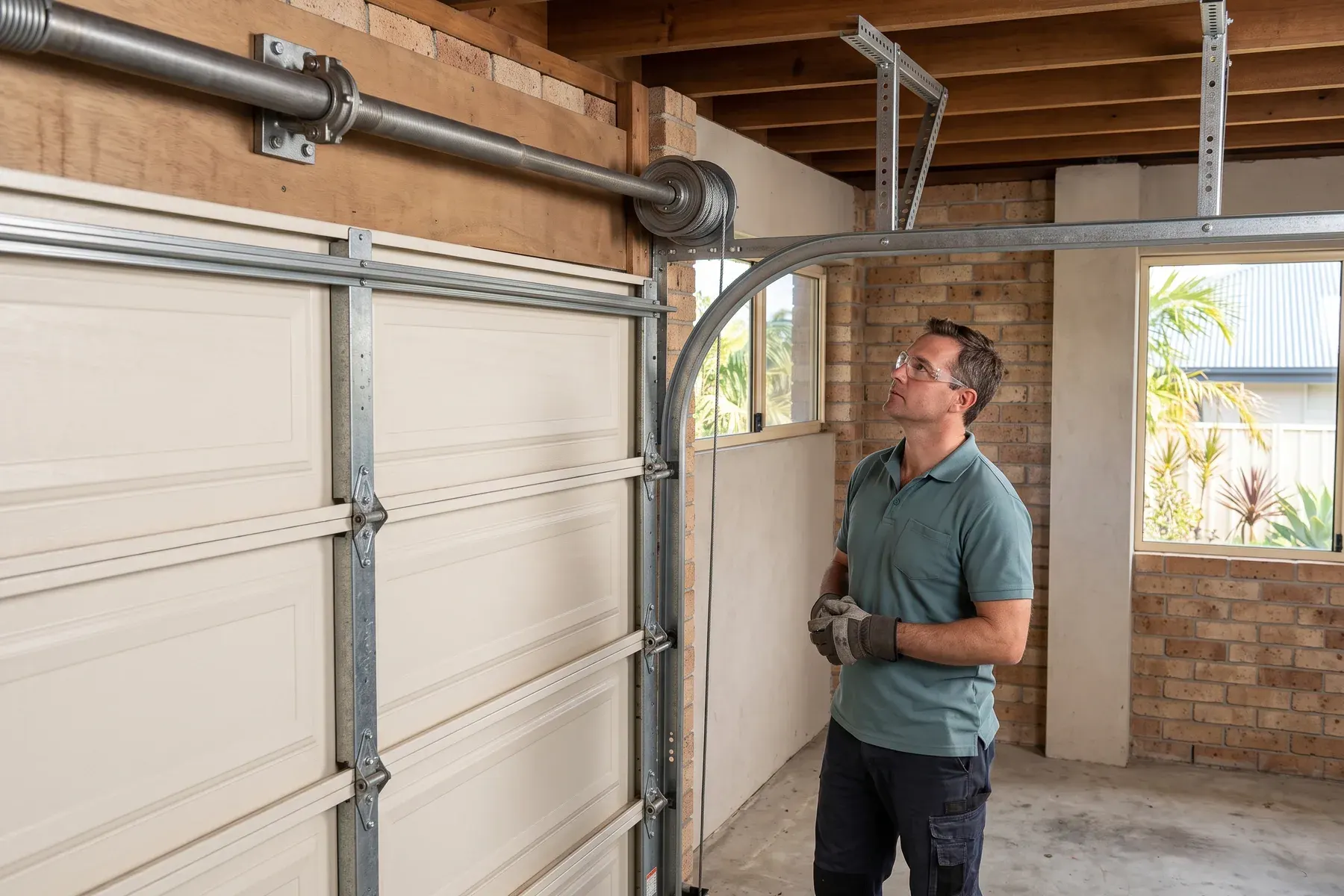
Cables, tracks, rollers and hinges are the running gear of a sectional door. When one of them goes, the symptom is usually a door that binds, sits crooked, or comes out of its tracks.
This page explains how these components interact, why a single worn roller can end up as an off-track door, and what makes a door safe or unsafe to keep using.
The problem
This group of components has a particular characteristic: individual parts are inexpensive and quick to replace, but a small fault that is left alone tends to damage its neighbours. A roller with a flat spot drags. Dragging pulls a hinge. A pulled hinge lets a panel sit slightly out of line. A misaligned panel puts a cable under uneven load. That is how a five-minute roller replacement becomes an off-track door.
The other characteristic is asymmetry. A sectional door is lifted by two cables working together. Anything that changes one side — a stretched cable, a cable that has jumped its drum, a bent track — makes the door lift unevenly. An uneven door is the most reliable outward sign that something in this group has failed.
The practical message is that binding, scraping and crookedness are worth acting on early. They rarely fix themselves and they usually get more expensive.
How it works
These parts are visible from inside the garage, which makes them easier to describe than a spring or a barrel.
Fault groups
Matching your observation to one of these makes the phone call much shorter.
What you notice: Visible broken strands, a slack cable, the door sitting low on one side.
Stop using the door. A second cable failure leaves the door unsupported.
What you notice: A loop of cable hanging near the shaft; the door jammed part-way and crooked.
Re-seating a cable requires the spring tension to be managed. It is not a pull-it-back job.
What you notice: A rhythmic thump or squeal at one point in travel; a wheel that no longer spins freely.
Cheap to replace early, expensive once it has pulled a hinge or marked a track.
What you notice: The door binds at the same height every time; a visible kink or a gap between the track and the wall.
Often follows an impact, a loosened bracket, or repeated operation against an obstruction.
What you notice: A panel edge sitting proud, a gap opening between sections, a rattle under load.
Common on older doors and on doors that have been forced.
What you notice: Rollers clear of the track, the door wedged at an angle.
The end state of most of the faults above. Keep clear and do not attempt to reseat it.
Safety boundary
Cables stay under tension when the door is closed, and a door that has lost alignment can move unpredictably.
If someone is injured, or there is a fire or electrical emergency, call 000 first.
Symptom check
Observed behaviour only. A provider confirms the cause in person.
| What the door does | What you hear | What you can see | Safe next step |
|---|---|---|---|
| Stop using the door Door lifts unevenly, one side leading | A knock at one side | One cable slack, or a loop near the drum | Stop using it and say which side sits low. |
| Stop using the door Door jammed part-way and crooked | A bind or a crunch | A roller clear of its track | Leave it. Do not attempt to reseat the roller. |
| Use with care Door binds at the same point each cycle | A repeated scrape or thump | A kink in the track or a marked roller | Arrange an inspection before it pulls a hinge. |
| Use with care A gap opening between two panels | A rattle under load | A cracked hinge or an elongated fixing hole | Stop routine use; panel alignment affects the cables. |
| Plan a look Squealing on every cycle | A dry squeal | A roller that does not spin freely by hand | A worn roller. Cheap now, expensive later. See servicing and maintenance. |
What is involved
Scope is set by the attending provider. Typically:
Cost factors
This is usually the least expensive group of garage door repairs — provided the fault is caught before it spreads.
No price is published here. A figure invented before a provider has seen the door would not help you compare quotes, and this site does not quote.
One roller is a small job. A cable, two rollers, a hinge and a straightened track is a different visit, and that escalation is the normal consequence of waiting.
Re-tracking a door means releasing load, restoring alignment and re-checking balance, not simply lifting rollers back in.
A lightly bowed track may be corrected. A kinked or creased section is generally replaced, and vertical and horizontal sections differ in cost.
Nylon rollers with sealed bearings usually run quieter and last longer than basic steel rollers. Ask what is being fitted and why.
Cables are replaced in pairs so both sides behave the same way. Drum condition and setting are checked at the same time.
Coastal exposure attacks cables, roller bearings and fixings. Corroded hardware may need replacing rather than adjusting.
If a provider recommends replacing both cables when only one is frayed, that is normal practice for keeping the door balanced — but ask them to explain it for your door.
Decision guide
Running gear is repairable more often than any other group. The replace conversation is really about the door around it.
| Factor | Points towards repair | Points towards replacement |
|---|---|---|
| Fault type | Cables, rollers, hinges, brackets or a single track section. | Frame distortion or panel damage that alignment work cannot correct. |
| Panel condition | Panels straight and sound. | Panels creased, delaminated or previously repaired from impact. |
| Recurrence | First occurrence with a clear cause. | The door repeatedly leaves its tracks despite correct alignment. |
| Corrosion | Hardware corrosion that can be replaced piece by piece. | Corrosion in the panels or the bottom section itself. |
| Age and matching | Standard components readily available. | Discontinued track profile or hardware that no longer matches. |
Running-gear faults are usually worth repairing. If the same door keeps coming out of its tracks after correct alignment work, that is the signal to look at the door as a whole rather than the next component.
Suitability
Access and setting change the work more than people expect.
Call preparation
These components are visible, so a short look from the ground pays off.
Everything on this list can be observed from the ground or from memory. Do not go near a spring, a cable or a bottom bracket to answer any of it.
Questions
No. A door that has left its tracks has usually done so because the load path has changed, and the cables remain under tension. Lifting rollers back in without releasing and re-setting that load commonly bends the track further, damages panels, or lets the door drop.
Because the two cables have done identical work over identical time. Fitting one new cable alongside one worn cable leaves the door lifting unevenly and the second failure usually follows. Ask the provider to explain the recommendation for your door.
Sometimes, but a squeal often means a roller bearing has dried out or is failing. Lubricating a failing roller quietens it without fixing it. Follow the manufacturer's guidance for your door on what to lubricate and what to leave alone — tracks in particular are usually kept clean rather than greased.
It depends on how badly it binds. A door that catches slightly is a soon job; a door that has to be forced past a kink is doing damage every cycle and should be taken out of service until it is looked at.
Nylon rollers with sealed bearings generally run more quietly and cope better with corrosive environments, which matters near the coast. The right choice depends on the door and how it is used, so ask the provider what they are fitting and why.
Next step
Tell us which side, what height and what you can see. Running-gear faults are the cheapest to fix early and the most expensive to ignore.