Garage Door Repair Gold Coast

Urgent garage door problems

Urgent Garage Door Repairs

If your garage door is stuck open, stuck closed or hanging out of its tracks, the priority is keeping people and vehicles away from it and getting an accurate description to someone who can attend.

This page explains what makes a garage door genuinely unsafe, what to do while you wait, and what to have ready so a provider can judge how urgent the job is.

Illustrative urgent garage door repairs assessment
  • Enquiries accepted across the Gold Coast
  • No arrival time is promised before a provider confirms
  • Phone enquiry only

The problem

What counts as urgent with a garage door

Not every garage door fault is an emergency, and treating every fault as one leads to rushed decisions. A door is genuinely urgent when it has stopped protecting the opening, when it is carrying its weight in a way it was not designed to, or when the failure has left an obvious hazard in a space people walk through.

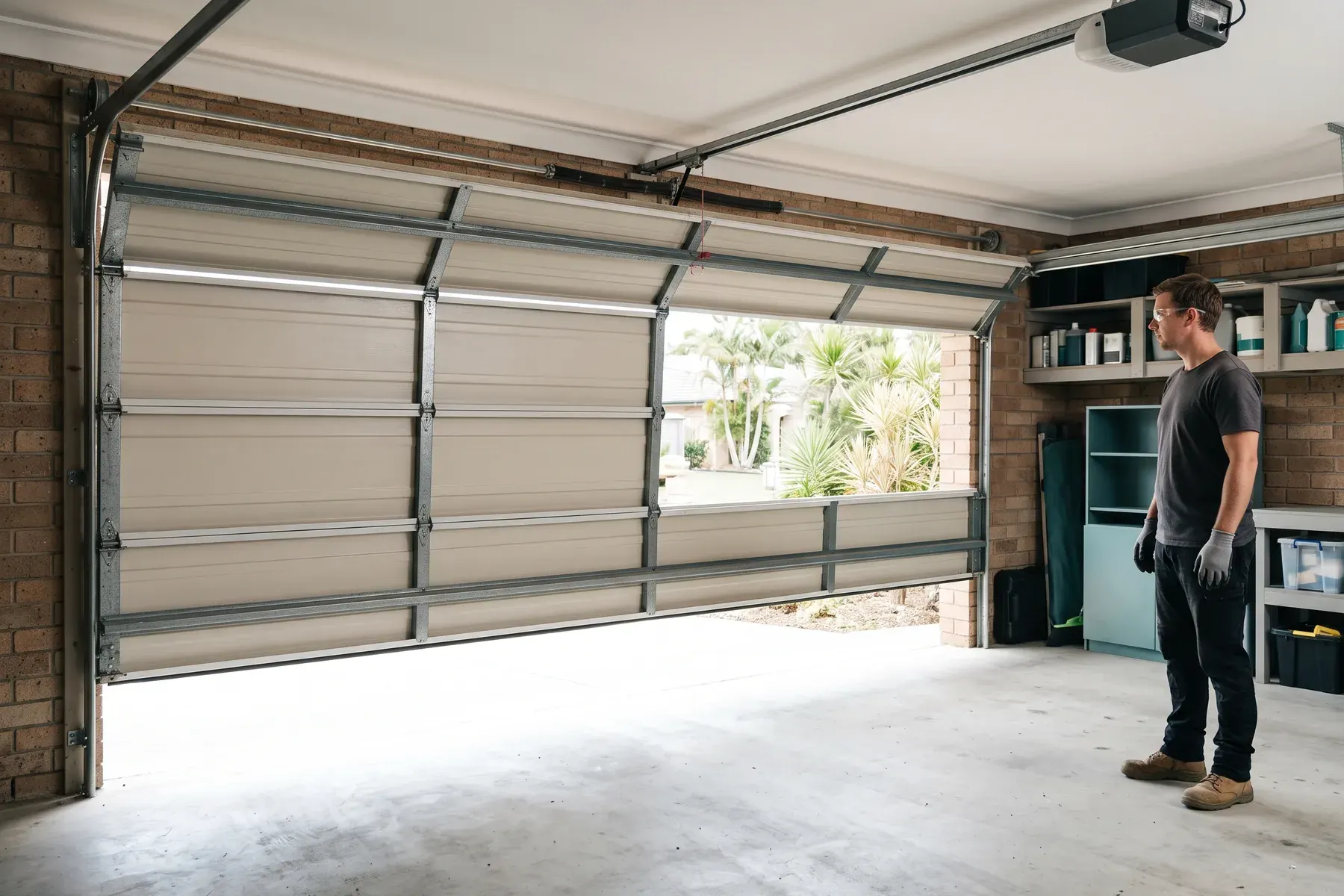
The three situations that usually justify treating a garage door as urgent are: the door is stuck open and the garage cannot be secured; the door is stuck closed and a vehicle or equipment is trapped inside; or the door is visibly crooked, off track, or held up by something other than its own springs and cables.

Everything else — a noisy door, a remote that works intermittently, a seal that has perished — is a repair worth booking, not an emergency. Describing which of these you have, accurately, is the single most useful thing you can do on the phone.
How it works

Why a failed door becomes dangerous

A residential garage door is heavy, and almost all of that weight is held by a counterbalance system rather than by the motor. Understanding that changes how you treat a failure.

The counterbalance carries the weight
Torsion or extension springs are wound or stretched to offset the mass of the door. The opener moves a balanced door; it does not lift an unbalanced one. When a spring fails, the full weight of the door transfers somewhere it should not be.
Cables and drums transfer that force
Lifting cables run from the bottom brackets to drums on the torsion shaft. A cable that has snapped, jumped its drum or frayed leaves the door supported unevenly, which is why a failed cable often shows as a door sitting crooked in the opening.
Tracks constrain the path, not the load
Tracks and rollers guide the door. They are not designed to hold a door that has lost its counterbalance, so a door resting on a bent track is in an unstable state even if it looks still.
Bottom brackets stay under tension
On a closed sectional door the bottom brackets remain loaded by the cables. They are a well-known injury point and are not a component to loosen, adjust or investigate.

Fault groups

Fault groups behind most urgent calls

These are the categories a provider will be trying to place your description into. None of them can be confirmed without someone looking at the door.

Broken counterbalance spring

What you notice: A loud bang earlier, the door now extremely heavy by hand, the opener straining or reversing, a visible gap in a coiled spring above the door.

The door should be left closed if it is already closed. Do not use the opener to test it.

Failed or derailed lifting cable

What you notice: One side of the door higher than the other, a slack or hanging cable, the door binding in the tracks part-way through travel.

A crooked door can move suddenly when disturbed. Keep the area clear.

Door off track

What you notice: Rollers visibly out of the track, a bowed or kinked track, the door wedged at an angle and not responding to the opener.

Forcing an off-track door usually damages panels or the track further.

Impact damage

What you notice: A vehicle or object has struck the door; a panel is deformed, the bottom section is pushed in, or the track has been knocked out of alignment.

Even where the door still moves, alignment and balance need checking before regular use.

Opener or power failure with the door closed

What you notice: No response from the wall control or remote, no motor sound, the door closed and the vehicle inside.

This is inconvenient rather than dangerous, and the manual release is designed for it.

Safety boundary

Where the safe boundary sits

A garage door that has lost part of its counterbalance can move without warning. The safe response is distance, not investigation.

If someone is injured, or there is a fire or electrical emergency, call 000 first.

Do this while you wait

  • Move vehicles, bicycles and bins out from under and beside the door if you can do so without going under it.
  • Keep children and pets out of the garage entirely until the door has been assessed.
  • If the door is stuck open and the garage cannot be secured, move valuables and secure the internal door to the house.
  • Note what you heard and saw when it failed — a bang, a grinding noise, a jolt — and when it happened.

Do not attempt

  • Do not try to force, lever or lift a door that is jammed, crooked or off track.
  • Do not loosen, adjust or remove a spring, cable, drum or bottom bracket.
  • Do not keep pressing the opener button to see whether it will go this time.
  • Do not prop the door with a ladder, timber or a vehicle jack.
  • Do not stand or walk under a door that is partly open.

Symptom check

Matching symptoms to a safe next step

Observed behaviour only. A provider confirms the cause in person.

Observed behaviour only. A garage door cannot be diagnosed remotely, and the same symptom can have more than one cause.
What the door does What you hear What you can see Safe next step
Stop using the door Door stopped part-way and sits crooked Grinding, or nothing at all One side higher than the other; a cable slack or off its drum Keep everyone clear and describe which side is low when you call.
Stop using the door Door will not lift; opener strains and reverses A bang earlier, motor running then stopping A gap in the coiled spring above the door Leave the door closed and do not use the opener again.
Stop using the door Door stuck open and will not come down Clicking from the opener, or silence Rollers out of the track, or an obstruction in the photo-eye beam Secure the opening as best you can and call to describe what you can see.
Use with care Door closed, vehicle inside, nothing responds No motor sound at all No opener light; other power in the garage may also be off Check whether the circuit has tripped, then ask about the manual release when you call.
Use with care Door moves but scrapes or catches at one point A repeated scrape or knock at the same height A bent track section, a flat spot on a roller, or a loose hinge Stop routine use and arrange a look before it worsens. See cable, track and roller repairs.

What is involved

What an urgent attendance usually covers

Scope varies by provider and by what is actually found. This is the shape of the work rather than a commitment on behalf of any particular provider.

  • Making the immediate situation safe — securing the opening, or stabilising a door that is unsupported.
  • Identifying the failed component and whether the failure has damaged anything else.
  • Confirming whether a repair can be completed on the visit or whether a part has to be ordered.
  • Checking balance and travel after any repair, because a door that moves is not necessarily a door that is balanced.
  • Explaining what caused the failure where that is knowable, so the same fault is less likely to repeat.

Not included

  • A quote or diagnosis given over the phone before anyone has seen the door.
  • Structural building work, rendering or rectifying damage to the building around the opening.
  • Electrical work beyond the opener itself, which may require an appropriately licensed trade depending on scope.

Cost factors

What changes the cost of urgent repairs

Urgent work is priced by the provider who attends, not by this site. These are the variables that most often move the figure.

No price is published here. A figure invented before a provider has seen the door would not help you compare quotes, and this site does not quote.

What actually failed Biggest single factor

Replacing a single roller is a different job from replacing a paired spring set, re-cabling a door and rebalancing it. The failed component determines both the parts and the labour.

Whether the failure caused secondary damage Often underestimated

A door that came off track under power may also have a bent track, a damaged panel or a distorted bracket. Secondary damage is common and is usually discovered on site rather than described on the phone.

Door construction and weight Parts and labour

A large double sectional door with heavy panels carries different hardware from a single roller door, and the counterbalance components are sized to it.

Part availability Timing more than price

Common springs, rollers and cables are widely stocked. Panels, older opener boards and less common profiles may need ordering, which can turn one visit into two.

Access at the property Labour time

A steep or short driveway, a narrow garage, stored contents against the walls, or a door in a complex with restricted access all add time to the visit.

When the work happens Provider dependent

Attendance outside normal hours is charged differently by different providers. Ask directly rather than assuming, and confirm it before agreeing to the visit.

Because this site does not attend or quote, the only honest advice on price is to get the figure from the provider before work starts, and to ask what happens if a second component is found to be damaged.

Suitability

How the urgency question usually resolves

Providers triage. Being accurate about which situation you are in helps you get a sensible answer rather than an optimistic one.

Door open, property cannot be secured
Usually treated as the highest priority, because the risk is to the property rather than to the door. Say so clearly and mention whether there is an internal door you can lock.
Door closed, vehicle trapped, no other transport
Often solvable in the short term with the manual release, which disconnects the door from the opener. Ask about it on the call rather than experimenting with a door you suspect is unbalanced.
Door closed and secure, mechanism failed
Usually a next-available repair rather than an after-hours call-out. Leaving it closed and unused is the safest holding position.
Damage after a storm or an impact
Worth photographing before anything is moved, in case an insurer becomes involved. Mention on the call whether you intend to claim, because it can change what documentation the provider records.

Call preparation

What to have ready when you call about urgent repairs

An urgent call goes better when the first thirty seconds contain the right facts. Have these ready.

  1. Suburb and street access Where the property is, and whether a van can get close to the door.
  2. Door type Roller (curls into a drum) or sectional / panel-lift (hinged panels that run overhead).
  3. Current position Fully open, fully closed, or stuck part-way — and whether it is level.
  4. What you heard A bang, a grind, a click, or nothing. When it happened.
  5. Whether anything is trapped A vehicle, equipment, or access to the only entry point.
  6. What you can see A broken spring, a hanging cable, a roller out of its track, a dented panel.
  7. Opener brand Read it off the motor housing only if you can do so safely from the ground.
  8. Property type House, townhouse, duplex, or a unit in a complex with a body corporate.

Everything on this list can be observed from the ground or from memory. Do not go near a spring, a cable or a bottom bracket to answer any of it.

Questions

Questions about this repair

Is a garage door stuck open an emergency?

It is usually the most urgent of the common garage door faults, because the opening cannot be secured. Whether a provider treats it as after-hours work depends on their own availability, which is why this site does not promise an attendance window.

Can I use the manual release to close a door with a broken spring?

The manual release disconnects the door from the opener; it does not restore the counterbalance. With a broken spring the door can be extremely heavy and can drop. Ask the provider on the phone before pulling it, and describe what you can see.

Should I keep pressing the button to see if it will work?

No. If a door has jammed or lost its balance, repeated attempts commonly bend a track, break a roller off its stem or damage a panel, which turns a single-component repair into a larger one.

The door closed but now sits crooked. Can I still use it?

Treat a crooked door as out of service. An uneven door usually means a cable or spring problem, and continued use tends to worsen the alignment and can bring the door out of its tracks entirely.

Will someone definitely attend tonight?

No one can promise that here. This site takes the enquiry and may refer it to a suitable independent provider, who decides whether they can attend and when. If nobody can attend and the situation is unsafe, make other arrangements for security.

Next step

Describe the door and we will take it from there

Call and describe what the door is doing, what you can see and where the property is.

  • You get to describe an urgent situation to a person rather than a form.
  • The enquiry is passed on with the detail a provider actually needs to triage it.
  • You are told plainly if a provider cannot be confirmed, rather than left waiting.