Curtain out of the guides
What you notice: One side of the curtain has pulled clear; the door binds hard and sits crooked.
Do not force it back. The curtain edge and the guide are both easy to damage further.
Roller door faults
A roller door hides most of its mechanism inside the barrel, so faults usually show up as behaviour — jamming, rubbing, dropping or sitting crooked — rather than as a visibly broken part.
This page explains how a roller door differs from a sectional door, what the common failures look like from the outside, and what makes coastal Gold Coast installations worth watching.
The problem
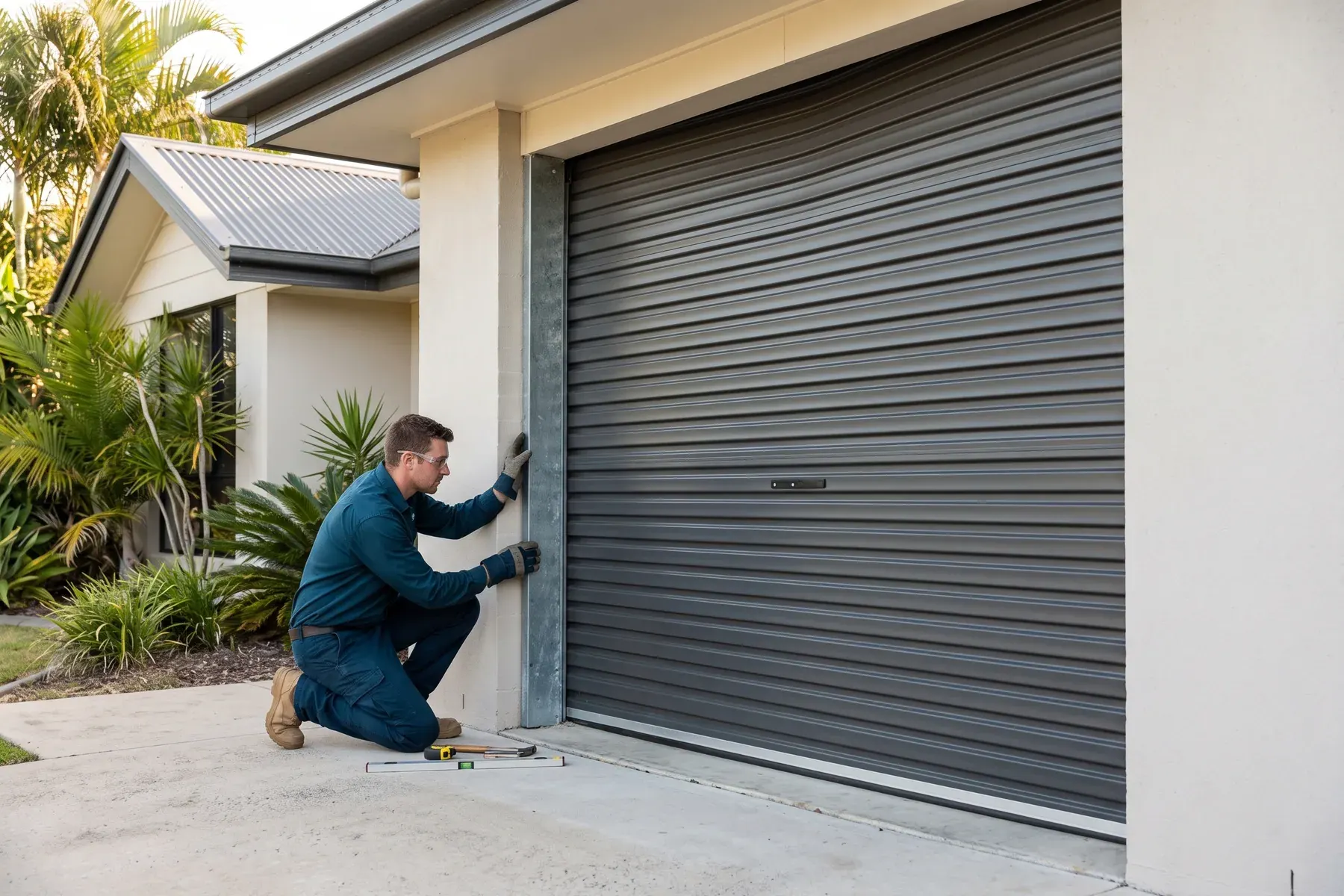
A roller door is a single sheet of profiled steel — the curtain — that curls onto a barrel above the opening. Instead of hinged panels running on overhead tracks, it runs in two vertical side guides. The counterbalance spring assembly sits inside the barrel, out of sight.
That construction changes the fault pattern. There are no hinges or overhead rollers to fail, but the curtain itself can be bent, the guides can be pinched or filled with debris, and the barrel can be knocked out of true. Because the spring is enclosed, a counterbalance failure shows up as a curtain that will not stay up or that drops quickly, rather than as a visible broken coil.
The other practical difference is that a roller curtain can jump its guides. A door that has come out on one side will usually bind hard and should be left alone rather than worked back by force.
How it works
Naming these accurately on the phone genuinely narrows the fault.
Fault groups
Most roller door enquiries land in one of these groups.
What you notice: One side of the curtain has pulled clear; the door binds hard and sits crooked.
Do not force it back. The curtain edge and the guide are both easy to damage further.
What you notice: A scraping noise at the same point each time; effort needed at one height.
Debris, a loosened guide fixing or a slight bow in the curtain are all candidates.
What you notice: The door drops faster than it should, will not stay up, or feels much heavier than it did.
The spring is inside the barrel, so this is judged by behaviour rather than by looking.
What you notice: A visible dent, a bowed curtain, or a door that no longer sits square after a storm or a knock.
Worth photographing before anything moves in case an insurer is involved.
What you notice: Rust staining, rough movement, seized locks. More common with sustained salt exposure.
Cleaning and lubrication follow the manufacturer's guidance for the specific door.
What you notice: Barrel motor runs but the curtain does not move; door stops short; remote failures.
Overlaps with opener work; the checks are similar even though the hardware differs.
Safety boundary
A roller curtain that has jumped its guide is under uneven load and can move suddenly. The internal spring assembly is not something to open.
If someone is injured, or there is a fire or electrical emergency, call 000 first.
Symptom check
Observed behaviour only. A provider confirms the cause in person.
| What the door does | What you hear | What you can see | Safe next step |
|---|---|---|---|
| Stop using the door Curtain jammed and crooked | A bind or crunch, then nothing | Curtain edge clear of one guide | Leave it. Describe which side came out and at what height. |
| Stop using the door Door drops quickly when released | A rush as it comes down | Nothing obvious — the spring is enclosed | Stop using it and mention the drop when you call. |
| Use with care Door scrapes at the same height each time | A repeated scrape or squeal | A mark on the curtain, or debris in a guide | Clear the guides from the ground and arrange an inspection. |
| Use with care Door will not fully close or seal | Normal travel then a stop | A gap at the floor, or a bent bottom rail | Note the gap size. It may be limits, the rail or the floor level. |
| Use with care Motor runs, curtain does not move | Motor sound with no travel | Barrel not turning with the motor | Points at the drive rather than the curtain. See motor and opener repairs. |
| Plan a look Rust marks and stiff movement near the coast | A dry grinding | Staining at the bottom rail and in the guides | Maintenance rather than a fault, but worth acting on early. See servicing and maintenance. |
What is involved
The attending provider decides scope. The typical shape is:
Cost factors
Roller door costs are dominated by whether the curtain itself is damaged.
No price is published here. A figure invented before a provider has seen the door would not help you compare quotes, and this site does not quote.
Guides, locks and bottom rails are replaceable items. A bowed, creased or corroded curtain is a much larger conversation, because the curtain is effectively the door.
A wide double roller door carries a heavier curtain and a larger barrel assembly than a single garage or a carport door.
Work inside the barrel requires the curtain to be handled carefully and the assembly to be set correctly. It is not a quick adjustment.
Damaged guides or barrel brackets are individually replaceable, but alignment across the whole opening has to be re-established afterwards.
Surface corrosion on hardware is manageable. Corrosion through the curtain or the bottom rail changes the recommendation.
Whether the fault is mechanical, electrical or both determines how much of the job is door work and how much is opener work.
The question worth asking is whether the curtain can be trued and reused, or whether the recommendation is a new curtain — those are very different jobs.
Decision guide
For roller doors the repair-or-replace line usually runs through the curtain.
| Factor | Points towards repair | Points towards replacement |
|---|---|---|
| What is damaged | Guides, brackets, bottom rail, locks, motor. | The curtain itself is bowed, creased across its width or corroded through. |
| Extent of impact damage | A localised dent that does not affect travel. | Damage across several corrugations, or a curtain that no longer rolls true. |
| Corrosion | Surface marking on guides and fixings. | Perforation at the bottom rail or along the curtain edges. |
| Repeat problems | A single fault with an identifiable cause. | The door keeps coming out of its guides despite alignment work. |
| Availability | Standard guides and hardware readily matched. | Obsolete profile or a colour and rib pattern that can no longer be matched. |
A localised dent that does not affect travel is often left alone. A curtain that will not roll true is usually a replacement, and the honest answer is that this needs to be seen rather than described.
Suitability
Roller doors are common across the region, and the setting affects what tends to go wrong.
Call preparation
Describing a roller door well means describing behaviour, because the mechanism is hidden.
Everything on this list can be observed from the ground or from memory. Do not go near a spring, a cable or a bottom bracket to answer any of it.
Questions
It is not advisable. The curtain edge is thin steel and the guide is easily distorted, so forcing it usually converts a repair into a curtain replacement. Leave the door where it is, keep the area clear, and describe which side came out and at what height.
That behaviour points at the counterbalance inside the barrel losing tension. Because the assembly is enclosed there is nothing to see from the ground — it is judged by how the door moves. Treat a fast-dropping door as out of service.
Sometimes. A localised dent that does not affect how the curtain rolls is often left alone. Damage across several corrugations, or anything that stops the curtain rolling true, generally points at a new curtain. It has to be assessed in person.
Manufacturers publish care guidance for coastal exposure, typically involving regular fresh-water washing of the door and hardware and following the specific lubrication instructions for that model. Steel-Line, for example, publishes coastal care guidance for its doors. Always follow the instructions for your own door, since warranty conditions vary.
Commercial and industrial roller shutter capability is not claimed on this site. If your enquiry is for a commercial site, say so on the call so it can be assessed honestly rather than passed on inappropriately.
Next step
With a roller door, behaviour is the diagnosis: where it binds, whether it holds position, and what you can see at the guides and bottom rail.