Garage Door Repair Gold Coast

Gold Coast garage door repair enquiries

Garage Door Repair Gold Coast

Tell us what the door is doing — stuck, crooked, noisy, or not responding — and we will take the details and get them in front of someone who can look at it.

This site does not attend, diagnose or quote. What it does is help you work out what you are dealing with, keep you away from the parts that can hurt you, and get the right information in front of someone who can actually look at it.

Call about your garage door 0468 067 164

One phone conversation, no forms and no booking widgets.

Specialist inspecting the track of a sectional garage door
  • Enquiries accepted across 22 Gold Coast suburbs
  • Phone only — no forms, no chat, no email funnel
  • Referral model explained in plain terms

Start here

Most garage door faults fall into one of seven groups

A garage door is a heavy panel held almost entirely by a counterbalance spring, guided by tracks and rollers, and moved by a comparatively modest motor. Almost every fault is a failure in one of those three parts of the system.

Knowing which one you are describing changes the conversation completely. It decides whether the door is safe to keep using, whether the problem is likely to be a five-minute part or a two-visit job, and what a provider needs to bring. The tools on this page are built to get you to that point before you call.

What this site will not do is guess. The same symptom regularly has more than one cause, and a garage door can only be assessed properly in person.

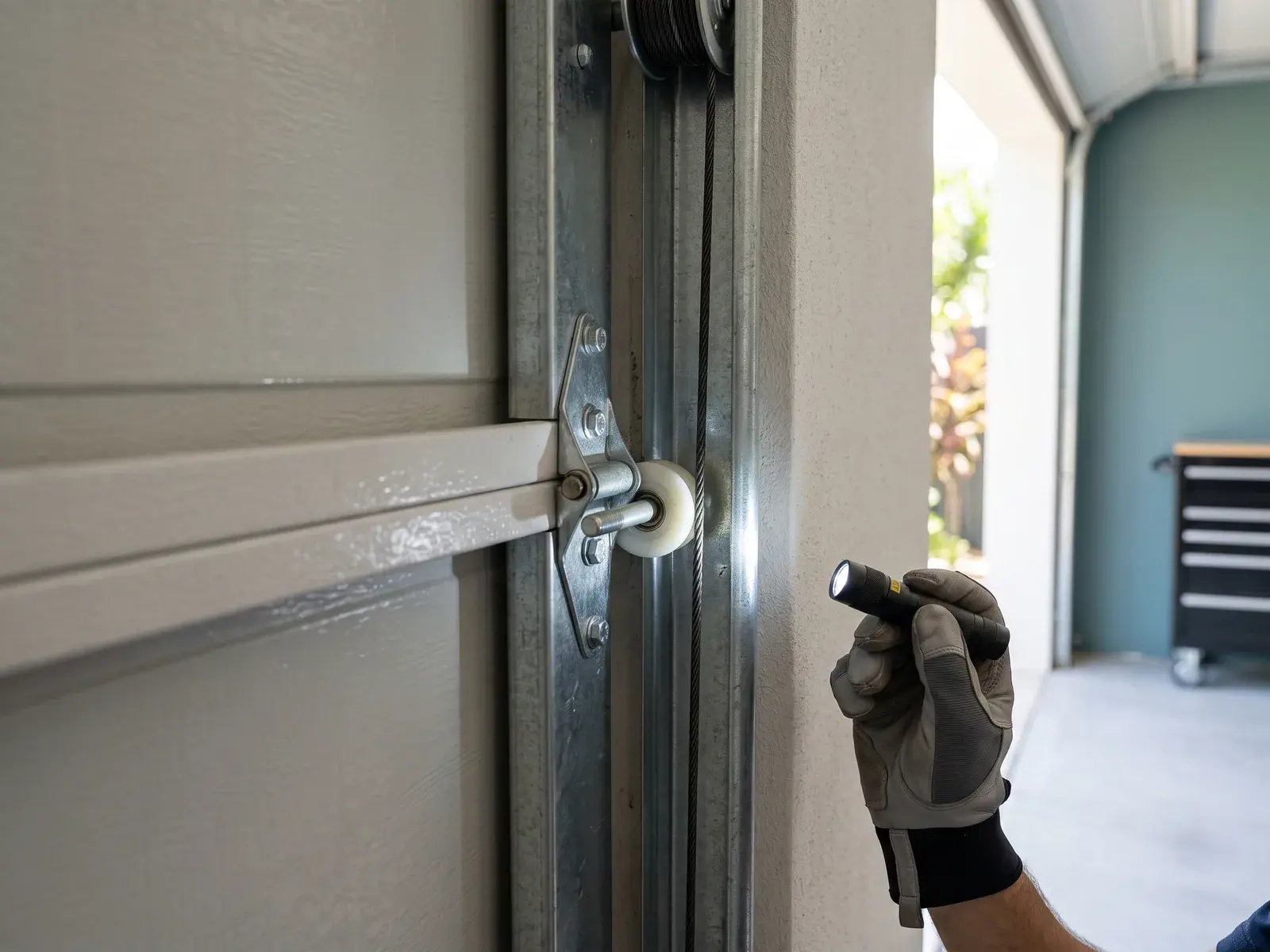
Close view of a garage door roller and track inspection
Illustrative image of garage door running gear: hinge, roller, track and lifting cable.

Symptom check

Match what your door is doing to a safe next step

Find the row that best describes what you can see and hear. The right-hand column is the safe action, not a diagnosis.

Observed behaviour only. A garage door cannot be diagnosed remotely, and the same symptom can have more than one cause.
What the door does What you hear What you can see Safe next step
Stop using the door Will not lift; opener strains and stops A bang earlier, then a labouring motor A gap in the coiled spring above the door Stop using the opener and leave the door closed. Broken springs.
Stop using the door Stopped part-way and sits crooked Grinding, or nothing One side lower; a cable slack or a roller out of its track Keep everyone clear. Do not try to straighten it. Cables, tracks and rollers.
Stop using the door Stuck open and will not come down A click from the opener, or silence An obstruction in the photo-eye beam, or a roller off track Secure the opening as best you can, then call. Urgent repairs.
Use with care Opens fine but will not close Motor runs then reverses A safety-eye light flashing or out Clear and wipe the beam path, then retest. Motors and openers.
Use with care Motor runs but the door does not move Motor sound with no travel The trolley moving without the door following An opener-side fault rather than a door fault. Motors and openers.
Stop using the door Roller curtain jams or drops fast A bind, or a rush as it comes down Curtain edge clear of a guide, or nothing visible at all Stop using it; the spring is inside the barrel. Roller doors.
Use with care Catches at the same height every cycle A repeated scrape or thump A bent track section or a roller with a flat spot Cheap to fix now, expensive once it pulls a hinge. Cables, tracks and rollers.
Plan a look Works, but feels heavier than it used to A creak on the way up Nothing obvious Balance drift. Worth a look before it becomes a failure. Servicing.

Safety boundary

If the door looks unsafe, stop using it

A door that has lost part of its counterbalance, or come out of its tracks, can move without warning. The right response is distance, not investigation.

If someone is injured, or there is a fire or electrical emergency, call 000 first.

Do this while you wait

  • Move vehicles, bikes and bins out from under and beside the door, without going under it.
  • Keep children and pets out of the garage until the door has been assessed.
  • If the door is stuck open, secure the internal door between the garage and the house.
  • Note what you heard when it failed, and when.

Do not attempt

  • Do not force, lever or lift a door that is jammed, crooked or off track.
  • Do not loosen, adjust or remove a spring, cable, drum or bottom bracket.
  • Do not keep pressing the opener button to see whether it will go this time.
  • Do not prop a door with a ladder, timber or a vehicle jack.
  • Do not stand or walk under a door that is partly open.

Door and component guide

Which part of the system are you describing?

Roller doors, sectional doors and openers fail in different ways. Picking the right vocabulary makes the phone call far more useful.

Choosing a category here does not confirm the fault. It helps you describe the problem accurately when you call, which is what a provider needs before quoting or attending.

Which best matches your door?

Sectional / panel-lift

Hinged horizontal sections that run up vertical tracks, round a radius and back along the ceiling. The most common door on newer Gold Coast homes.

  • Counterbalance is a torsion spring on a shaft above the opening — usually visible from inside.
  • Rollers, hinges and lifting cables are all visible, so faults can often be described accurately from the ground.
  • A single damaged section can sometimes be replaced, subject to matching the profile and colour.
  • Wide double doors use struts across the sections to stop them bowing.

Sectional and panel-lift door repairs

Roller door

A single sheet of profiled steel — the curtain — that curls onto a barrel above the opening and runs in two vertical side guides.

  • The counterbalance spring sits inside the barrel, so a failure has to be judged by behaviour rather than by looking.
  • Common faults are the curtain jamming, rubbing in a guide, dropping too fast, or coming clear of a guide entirely.
  • Bottom rails, guides and locks are the first components to corrode in a salt-exposed position.
  • Where the door is automated the motor usually drives the barrel directly — there is no rail or trolley.

Roller door repairs

The opener, not the door

The motor supplies a modest push and pull to a door the springs are already holding. It does not carry the door's weight.

  • A door that opens but refuses to close is usually the safety beams rather than the motor.
  • A motor that runs without moving the door points at the drive, the trolley or a release left disengaged.
  • One dead remote is a handset issue; every control failing points at power or the receiver.
  • Turning the force setting up to make a door move hides a mechanical fault and weakens the safety reversal.

Motor and opener repairs

Not sure

That is a perfectly reasonable answer, and it is not a barrier to a useful phone call.

  • Describe what the door does rather than what you think is broken.
  • Say whether it moves at all, and whether it stops at the same point every time.
  • Say what you heard — a bang, a grind, a click, or nothing.
  • Say whether the door sits level in the opening, and whether anything is trapped inside.

Browse the repair categories

Gold Coast coverage

Suburbs where enquiries are accepted

Each suburb page covers the local access, property and maintenance factors that genuinely differ across the coast.

Priority suburbs

Where the deepest local guidance is published.

Wider intake area

Enquiries accepted, with local context on each page.

Lead intake is approved across the suburbs listed on this site. That is where enquiries are accepted, not a promise that a provider is available in a given suburb at a given time.

Cost factors

What changes the cost of a garage door repair

No price is published on this site. These are the seven factors that actually move the number, so you can ask a provider the right questions.

No price is published here. A figure invented before a provider has seen the door would not help you compare quotes, and this site does not quote.

Which component failed The dominant factor

A roller, a cable set, a paired spring replacement, a control board and a door section sit at very different points on the scale. Everything else is secondary to this.

Door construction and size Parts and labour

A wide double sectional door carries heavier panels and larger counterbalance hardware than a single roller door, and the components are sized to it.

Whether the failure damaged anything else Commonly underestimated

A door that came off track under power often has a bent track, a marked panel or a distorted bracket as well. Secondary damage is usually found on site rather than described on the phone.

Part availability Timing as much as price

Common springs, cables and rollers are widely stocked. Panels, older opener boards and less common profiles may need ordering, which can turn one visit into two.

Access at the property Labour time

A steep or short driveway, restricted headroom, a garage packed with stored contents or a complex with controlled access all add time to the visit.

Urgency and timing Provider dependent

Attendance outside normal hours is charged differently by different providers. Ask directly and confirm it before agreeing to the visit.

Corrosion in coastal positions Scope

Where salt exposure has been at work, components tend to have aged together, so one failure often reveals two or three items that are near the end of their life.

If a figure matters to you before anyone attends, ask the provider what their assessment or call-out arrangement is, and what happens if a second component is found to be damaged once work starts.

Decision guide

Repair or replace: what actually shifts the answer

Most single-component failures on a sound door are repairs. Replacement enters the conversation when several of the right-hand column apply at once.

Criteria that push an assessment towards repair or towards replacement. Neither column decides the outcome on its own.
Factor Points towards repair Points towards replacement
What has failed One identifiable component: a spring, a cable, a roller, a hinge, a panel or an opener part. Several components at once, or a failure that has distorted the frame or the tracks.
Condition of the door itself Panels or curtain straight, finish sound, hardware replaceable individually. Creased or delaminated panels, a curtain that will not roll true, or corrosion through a section.
Failure history First fault, or the first in many years of ordinary use. Repeated failures across different components in a short period.
Corrosion Surface marking on hardware that can be replaced piece by piece. Corrosion through the bottom section, the curtain or the structural parts of the door.
Parts and matching Standard springs, cables, rollers and hardware readily available. Discontinued profile, unmatched colour, or an opener whose parts are no longer supplied.
Safety systems Working photo-eyes and a reliable auto-reversal. A door or opener that cannot be made to reverse reliably on an obstruction.

No column wins on its own. The useful question to put to a provider is simple: if this is repaired, what is the next most likely failure on this door, and is that part still available?

Call preparation

What to have ready before you call

A caller who can describe the suburb, the door type, the symptom and the access gets a far more useful conversation than one who cannot. None of it requires touching the door.

  1. Your suburb So lead-intake coverage and realistic travel can be discussed honestly.
  2. Door type Roller door curling into a barrel, or a sectional door with hinged panels.
  3. What the door is doing Stuck open, stuck closed, part-way, crooked, or moving but noisy.
  4. What you heard A bang, a grind, a click, or nothing at all — and roughly when.
  5. Opener brand Read from the label on the motor housing, from the ground only.
  6. Anything trapped A vehicle, equipment, or the property's only secure access.
  7. Access Driveway slope and depth, parking, and whether a complex has controlled entry.
  8. Property type House, townhouse, duplex or a unit within a strata scheme.
  9. Photos Whether you can send images later if the provider asks for them.
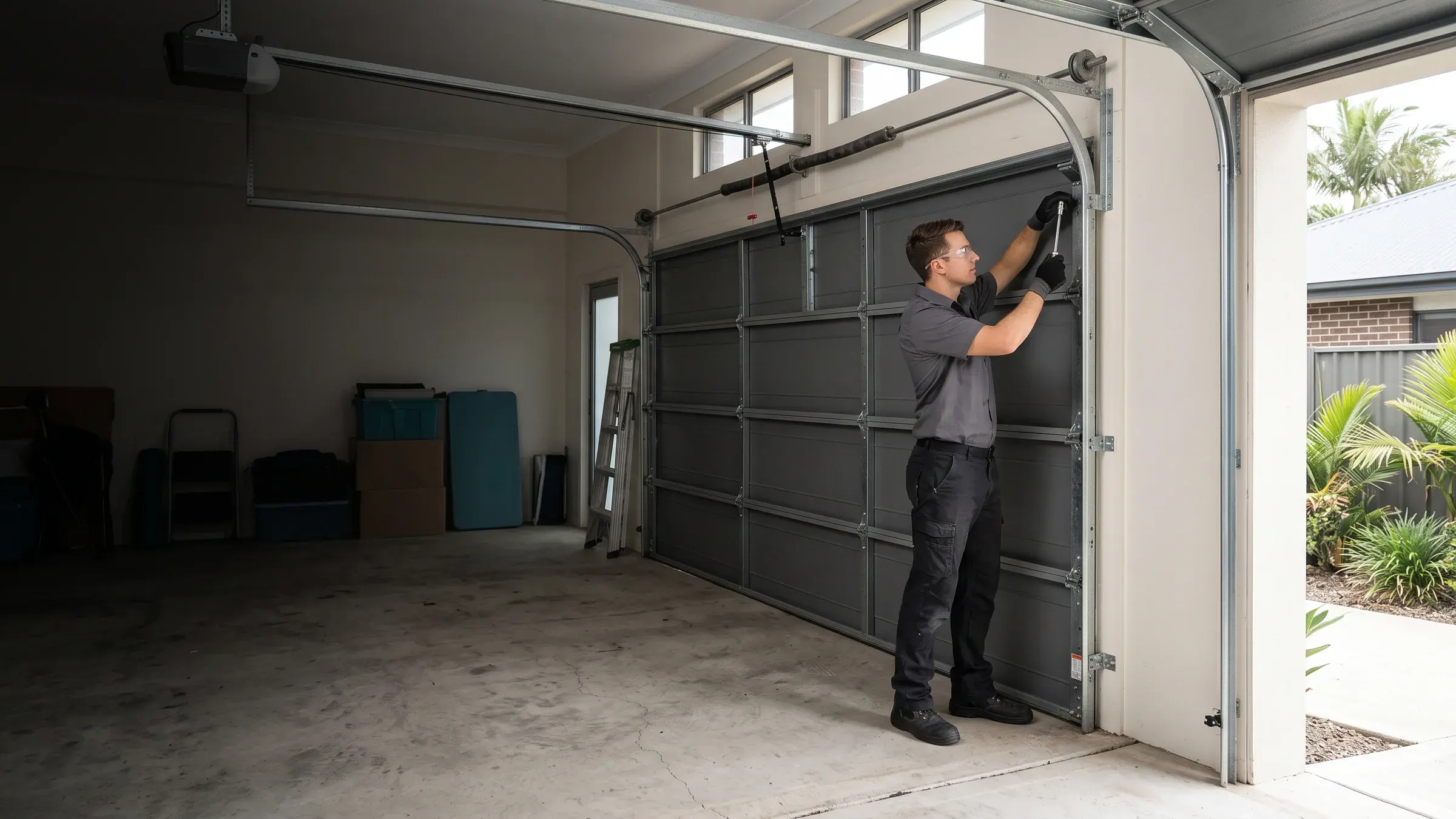
Do not go looking for information that requires you to get close to a spring, a cable or a bottom bracket. Everything on this list can be observed from the ground or from memory.

Questions

Questions people ask before calling

Short, direct answers. Where the honest answer is that nobody can know without looking, that is what it says.

What does a garage door repair cost on the Gold Coast?

No price is published here, because none has been verified for this market and an invented figure would not help you compare quotes. What this site does explain is the factors that move the number: which component failed, the door's construction and size, whether the failure damaged anything else, part availability, access and timing. Get the figure from the provider before work starts.

Is my garage door dangerous?

Treat it as unsafe if it is crooked, off track, sitting unevenly, extremely heavy by hand, or supported by anything other than its own springs and cables. In those situations keep people, pets and vehicles clear, do not force it, and do not keep pressing the opener button.

Can you tell me what is wrong over the phone?

No, and nobody honestly can. The same symptom has more than one possible cause, and a garage door can only be assessed properly in person. What a phone call does is establish the category of problem and the information a provider needs to attend prepared.

Which suburbs do you take enquiries from?

Lead intake is approved across the Tier 1 and Tier 2 suburbs listed on this site, from Ormeau and Pimpama in the north through the central suburbs to Elanora in the south. That is where enquiries are accepted — it is not a claim that a provider is available in a given suburb at a given time.

Do you offer 24/7 or same-day service?

No such claim is made here, because no availability has been verified. A provider who accepts the enquiry confirms their own timing with you directly. If nobody can be confirmed you will be told, so you can make other arrangements rather than wait on an implied promise.

Can I fix a broken garage door spring myself?

This site does not provide instructions for it. Spring replacement involves releasing and setting a large amount of stored energy with specific tools, and the consequences of getting it wrong are severe. It is the clearest case on the site for calling someone equipped for the job.

Next step

Call and describe the door

Suburb, door type, what it is doing and how urgent it is. That is all a first conversation needs.

  • You describe the problem to a person, not a form.
  • The enquiry is passed on with the detail a provider actually needs.
  • You are told plainly if a provider cannot be confirmed for your suburb.
  • There is no second funnel — no chat window, no callback queue, no email capture.