Power and supply
What you notice: No lights, no sound, nothing from any control. Sometimes other garage circuits are affected too.
Worth checking the circuit breaker and that the unit is plugged in before booking anything.
Automation and opener faults
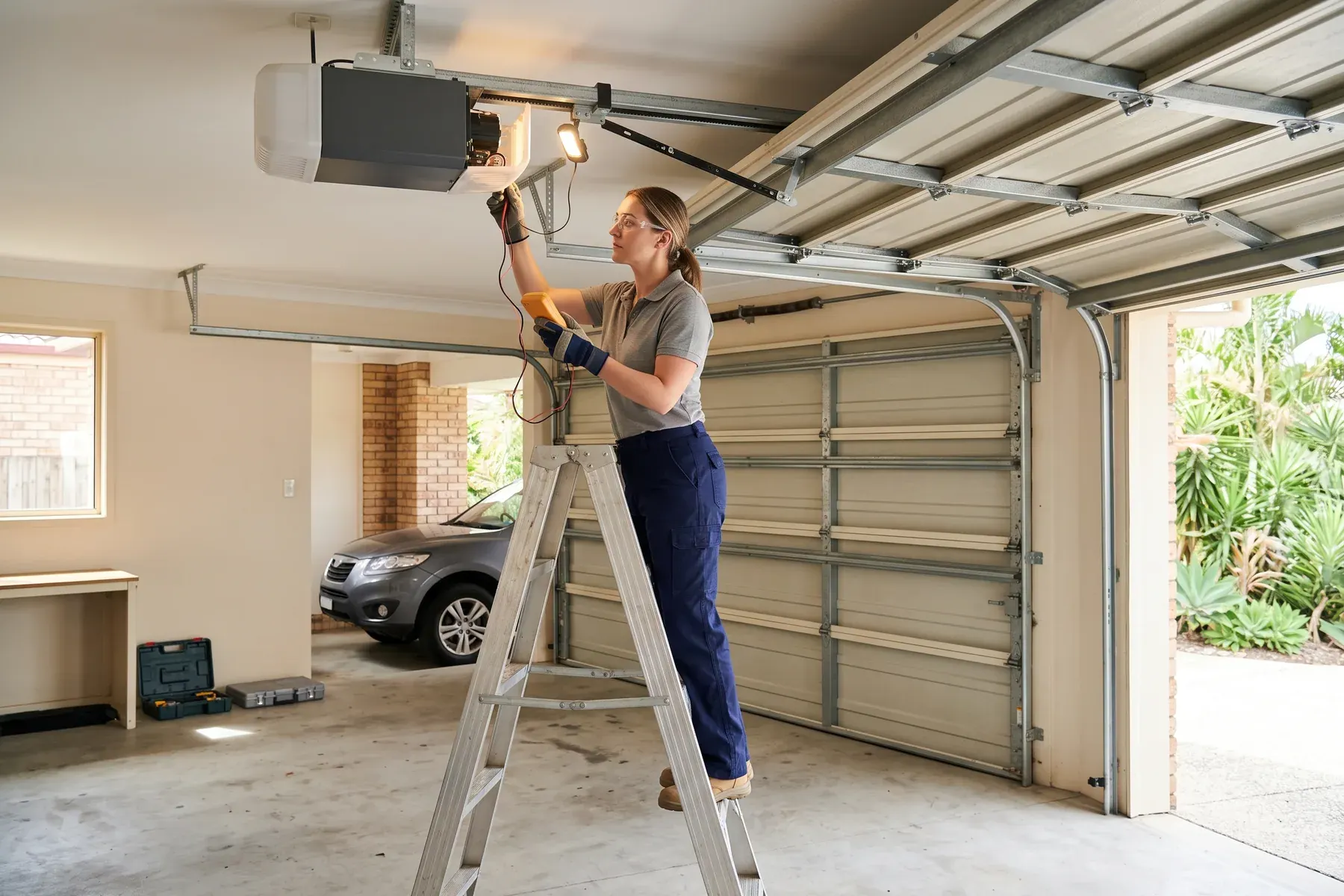
When a garage door stops working, the opener is blamed more often than it deserves. Separating an automation fault from a door-mechanism fault is the first useful step.
This page covers what an opener actually controls, the fault groups behind most opener calls, the checks that are safe to make yourself, and when a repair stops being worthwhile.
The problem
This is the single most useful idea on the page. A garage door opener does not carry the weight of the door — the springs do. The opener supplies a relatively modest push and pull to move a door that is already balanced.
That means a motor which sounds healthy but cannot move the door is very often reporting a mechanical problem rather than having one. Equally, a door that moves smoothly by hand but does not respond to a remote is far more likely to have a control, power or safety-beam fault.
The practical test — done only if the door is closed, sound and not suspected of a spring failure — is to disconnect the opener with the manual release and move the door by hand. Smooth and light points at the opener. Heavy, uneven or stiff points at the door.
How it works
Naming the part you are describing saves a lot of guesswork on the phone.
Fault groups
These categories cover the large majority of opener enquiries.
What you notice: No lights, no sound, nothing from any control. Sometimes other garage circuits are affected too.
Worth checking the circuit breaker and that the unit is plugged in before booking anything.
What you notice: Door opens fine but will not close, or closes part-way and reverses. Indicator LED flashing.
Cobwebs, a bin, a bike and direct low sun are all common causes. Cleaning the lenses is safe to do.
What you notice: One handset stops working, or all of them do. Range gets shorter over time.
A dead battery in one remote is different from a failed receiver. Test every control before calling.
What you notice: Door stops short, does not seal at the floor, or bounces back off the ground.
Adjustment is a setup task rather than a part failure, and it interacts with the safety reversal.
What you notice: Motor runs but the door does not move; grinding, slipping or a rattling chain or belt.
A stripped gear or a failed trolley is a genuine opener repair.
What you notice: Intermittent operation, humming without movement, or a unit that has stopped entirely with power present.
Board availability for older units is a real constraint and often drives the repair-or-replace decision.
Safety boundary
Most opener checks are safe. The line is crossed when a setting is changed to force a door that is telling you something mechanical is wrong.
If someone is injured, or there is a fire or electrical emergency, call 000 first.
Symptom check
Observed behaviour only. A provider confirms the cause in person.
| What the door does | What you hear | What you can see | Safe next step |
|---|---|---|---|
| Use with care Motor runs, door does not move | Motor sound with no movement, sometimes a grinding | Trolley moving along the rail without the door following | Points at a trolley, drive or gear fault rather than the door. |
| Use with care Door opens but will not close | A click, then the door stops or reverses | One safety-eye LED flashing or off | Clear and clean the beam path, then retest before calling. |
| Plan a look Nothing responds at all | Silence | No opener light, no LED on the wall control | Check the breaker and the plug, then call if power is present. |
| Plan a look Only one remote has stopped working | Normal | Other controls still operate the door | Try a fresh battery, then ask about pairing or a replacement handset. |
| Use with care Door reverses just before it closes | Motor runs the full travel then reverses | Door touches down then lifts again | Usually a limit, force or floor-contact issue — worth a proper setup check. |
| Stop using the door Opener strains and the door feels heavy by hand | Labouring motor | Door does not stay put at waist height when disconnected | Stop. This is a counterbalance problem, not an opener problem. See spring and balance repairs. |
What is involved
Scope is the provider's to set. Typically it includes both halves of the system.
Cost factors
Opener work spans a wide range because the fault groups are so different.
No price is published here. A figure invented before a provider has seen the door would not help you compare quotes, and this site does not quote.
Realigning safety beams or resetting travel limits is a setup task. Replacing a control board, drive gear or trolley brings a part into the equation.
A remote handset, a photo-eye pair, a drive gear set and a control board sit at very different points on the scale.
Boards and proprietary parts for discontinued models can be difficult or impossible to source, which is often what turns a repair into a replacement conversation.
Belt, chain, screw and direct-drive barrel units differ in what wears and how accessible it is.
If the mechanical door needs attention as well, the opener work is only part of the job. That is common when an opener has been compensating for a tiring counterbalance.
A high ceiling, a unit mounted awkwardly, or a garage full of stored contents all add time to the visit.
Ask whether the diagnosis is a setup issue or a part failure, whether the part is available for your model, and whether the door itself was checked as well as the motor.
Decision guide
Openers are the one area where replacement genuinely competes with repair, mostly because of part availability and safety features.
| Factor | Points towards repair | Points towards replacement |
|---|---|---|
| Fault type | Beams, limits, a remote, a trolley or a drive component. | Failed control board on a model whose parts are no longer supplied. |
| Age of the unit | Recent enough that parts are stocked and the unit is well supported. | Old enough that each repair buys a short extension and the next fault is likely. |
| Safety features | Working safety beams and a reliable auto-reversal. | No functioning photo-eyes, or a unit that cannot be made to reverse reliably. |
| Repair history | First fault, straightforward cause. | Several repairs in a short period across different components. |
| Fit with the door | Opener correctly matched to door weight and size. | Unit undersized for the door and consistently working at its limit. |
A useful question to ask the provider is simple: if this part is replaced, what is the next most likely failure on this unit, and is that part available? The answer usually settles the decision.
Suitability
The same symptom description means different things depending on the installation.
Call preparation
Opener faults are the easiest category to narrow down before you call, and doing so saves everyone time.
Everything on this list can be observed from the ground or from memory. Do not go near a spring, a cable or a bottom bracket to answer any of it.
Questions
On a rail-driven opener it usually means the drive is turning but the connection to the door is not — a stripped gear, a failed trolley, or a release that has been left disengaged. On a roller door with a barrel motor it points at the drive coupling. Either way it is an opener-side fault rather than a door-side one.
This pattern is characteristic of the safety beams. Most openers will allow opening with a broken beam but refuse to close. Check the lens path for obstructions, wipe both lenses, and look at whether the indicator LEDs are steady. Direct low sun into a lens can also cause it.
Please do not. Force settings exist so the opener stops when it meets resistance. Winding them up to overcome a mechanical problem removes the protection that stops a door closing on an obstruction, and it hides the real fault.
It depends entirely on the model and on whether parts are still supplied. This site will not claim that every make and model can be repaired. The attending provider confirms compatibility and availability for your specific unit.
Work on the opener unit itself is usually within a garage door provider's scope, but anything involving fixed wiring may require an appropriately licensed electrical trade depending on the work involved. Ask the provider what their scope covers rather than assuming.
Next step
Tell us which controls fail, what the motor does, and whether the door moves freely by hand. That usually separates an opener fault from a door fault straight away.