Balance drift
What you notice: The door no longer holds position when disconnected; it creeps up or down.
The clearest early indicator that the counterbalance is tiring.
Planned inspection and maintenance
Most garage door failures are preceded by weeks of small signals — a new noise, a slight bind, a door that feels heavier. A service is the point at which someone looks for those signals deliberately.
This page explains what a service typically inspects, what it is not, why coastal exposure changes the schedule, and where manufacturer instructions take priority over general advice.
The problem
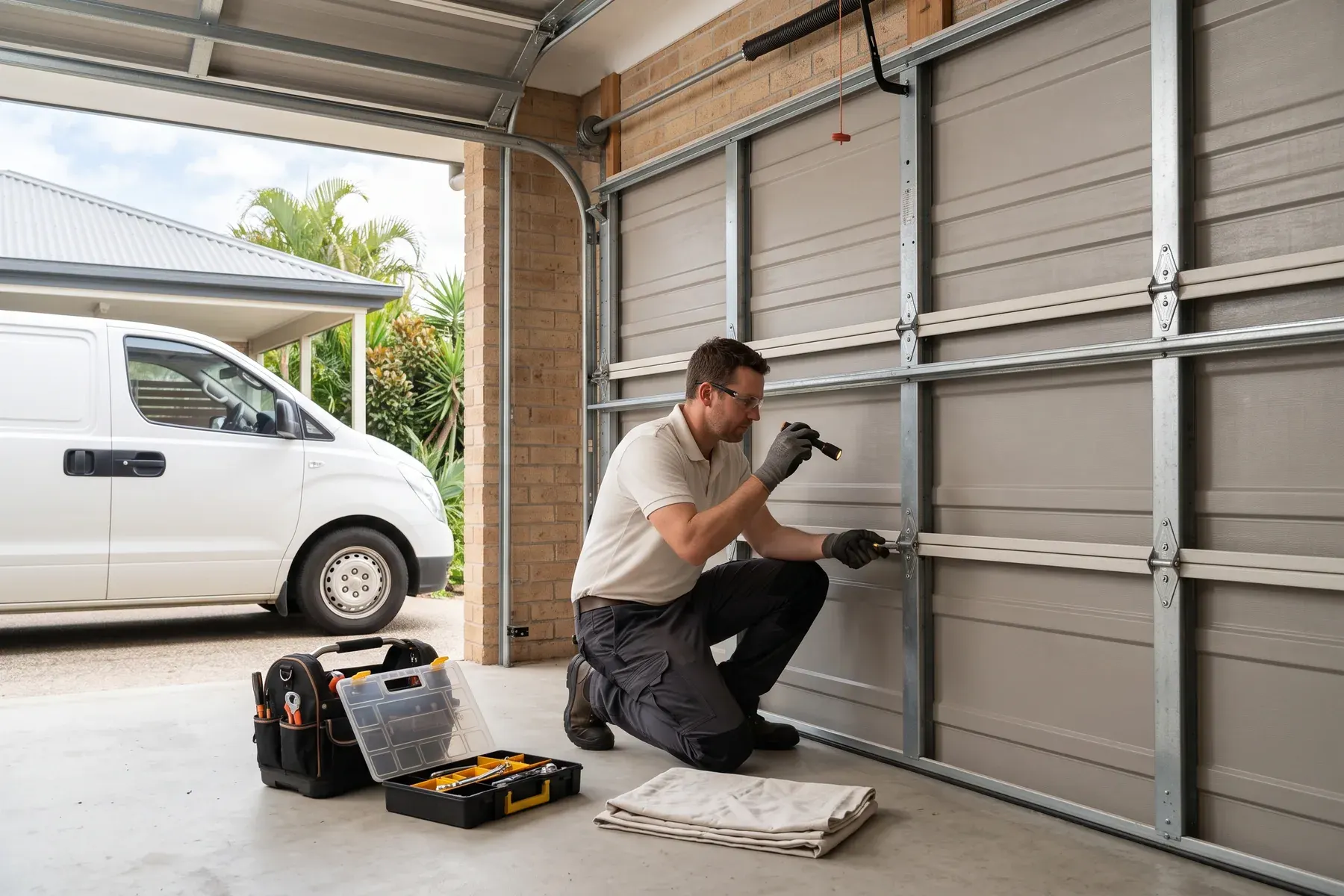
A garage door service is an inspection with adjustment, not a repair contract. Its value is in catching the things that are cheap now and expensive later: a roller that has started to drag, a cable strand that has begun to fray, an opener whose force setting has crept up to compensate for a tiring counterbalance.
It is also the standard point at which the safety systems are actually tested. An automated door has a reversal function that is supposed to stop and reverse when it meets resistance. That function degrades quietly, and most households never test it.
The honest limit is this: a service tells you the current condition of the door. It does not prevent a spring reaching the end of its cycle life, and it does not come with a guarantee that nothing will fail. Anyone promising that is overselling.
How it works
The inspection covers the door, the counterbalance and, where fitted, the automation.
Fault groups
These are the items that turn up repeatedly on doors that are still working.
What you notice: The door no longer holds position when disconnected; it creeps up or down.
The clearest early indicator that the counterbalance is tiring.
What you notice: Force settings higher than needed; the safety reversal slow or unreliable.
Often the result of somebody compensating for a mechanical problem instead of fixing it.
What you notice: A squeal, a thump, or a wheel that does not turn freely.
Cheap to replace during a service, expensive once it has pulled a hinge.
What you notice: A few broken strands, usually near the bottom bracket or at the drum.
Found only by looking. This is the single best argument for a periodic inspection.
What you notice: A rattle, a track bracket standing slightly proud, visible movement under load.
Straightforward to correct and easy to miss.
What you notice: Staining at hinges, fixings, bottom rails and guides.
Follow the door manufacturer's coastal care instructions; conditions vary by product and by warranty.
Safety boundary
Some maintenance is genuinely safe for a householder. The boundary is anything under tension and anything that changes a safety setting.
If someone is injured, or there is a fire or electrical emergency, call 000 first.
Symptom check
Observed behaviour only. A provider confirms the cause in person.
| What the door does | What you hear | What you can see | Safe next step |
|---|---|---|---|
| Plan a look Door works but feels heavier by hand | A creak on the way up | Nothing obvious | Balance check. This is exactly what a service is for. |
| Plan a look A new noise that was not there last month | Squeal, thump or rattle at a consistent point | Possibly a dry roller or a loose bracket | Note where in the travel it happens and book a look. |
| Stop using the door Door does not reverse on an obstruction | Motor continues against resistance | The door presses down instead of backing off | Stop using the automation and have the safety function checked. |
| Plan a look Rust marks appearing at hinges and fixings | Dry movement | Staining, blistering paint at section edges | Coastal maintenance. Follow the manufacturer's care instructions. |
| Plan a look Door has not been looked at in years | Normal | Nothing obvious | A first inspection usually finds several small items. |
What is involved
Every provider defines their own service. Ask what is included before booking, and ask what is charged separately.
Cost factors
Servicing is the most predictable cost on this site, but it still varies.
No price is published here. A figure invented before a provider has seen the door would not help you compare quotes, and this site does not quote.
Two doors at the same property in the same visit usually costs less than two separate visits.
An automated sectional door has more to test than a manual roller door — limits, force, photo-eyes and reversal all take time.
A door that has never been serviced usually generates a list of findings, which are quoted separately from the service itself.
Rollers, seals, hinges and cables found to need replacement are normally quoted at the time rather than included.
High ceilings, stored contents and restricted parking all add time to a visit.
Doors in exposed positions are commonly serviced more often, which changes annual cost rather than visit cost.
Ask what the service covers, what is quoted separately, and whether a written summary of findings is provided.
Suitability
Manufacturer instructions for your specific door take priority over any general schedule, including this one.
Call preparation
A service call is the easiest one to prepare for.
Everything on this list can be observed from the ground or from memory. Do not go near a spring, a cable or a bottom bracket to answer any of it.
Questions
Follow the maintenance schedule in your door and opener documentation — it is specific to the product and can affect warranty conditions. In general, higher-use and coastal-exposed doors are inspected more often than low-use doors in sheltered positions.
It checks that an automated door stops and reverses when it meets resistance while closing. It is one of the most important functions on the door and one of the least often tested. Your opener's manual describes the manufacturer's test method for your model.
Generally no. Most manufacturers specify keeping tracks clean rather than lubricated, because grease collects grit and accelerates roller wear. Lubrication belongs on the components the manufacturer nominates, in the way they nominate.
No. Springs are rated in cycles and will eventually reach the end of their life regardless of maintenance. What a service can do is spot a balance change, a corroded cable or an opener working too hard, so a failure is anticipated rather than a surprise.
In terms of corrosion, yes. Manufacturers publish coastal care guidance — typically regular fresh-water washing and specific lubrication instructions — precisely because salt exposure shortens hardware life. The right schedule is the one in your own door's documentation.
Next step
Tell us the door type, whether it is automated, and anything you have noticed changing. A service call is the cheapest conversation on this site.