The one rule that overrides everything below
Follow the maintenance instructions supplied with your own door and opener.
Manufacturers publish product-specific care guidance, and it differs between products, finishes and coastal ratings. It can also affect warranty conditions — a door maintained outside its schedule may not be covered in the way you assume.
Everything in this article is general context to help you understand why those instructions say what they say. Where the two conflict, your door’s own documentation wins.
Salt does not attack the door first
The intuition is that a coastal garage door rusts on its face. In practice, the visible door skin is usually the best-protected part of the whole assembly — it is finished, it is designed to be looked at, and it gets washed by rain.
The components that go first are the ones nobody looks at:
- Lifting cables. Steel strand, under tension, often in a corner where salt collects and airflow is poor. Corrosion works into the strand from the outside.
- Roller bearings. Small, sealed or semi-sealed, and they seize rather than fail dramatically.
- Hinge fixings and brackets. Fastener corrosion loosens hardware long before anything looks obviously wrong.
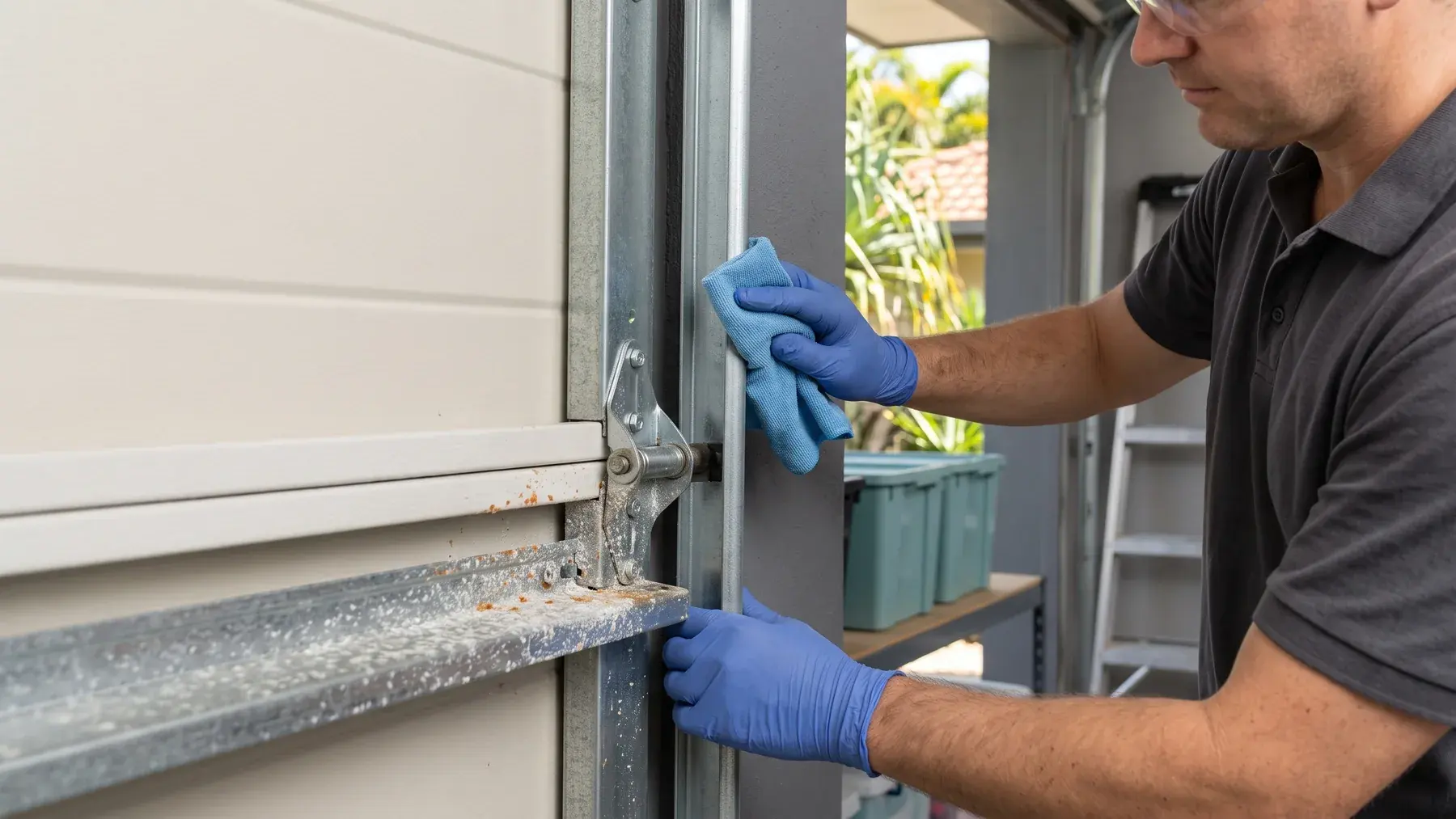
- Roller door guides, bottom rails and locks. On a roller door these are the first things to seize.
- The bottom section of a sectional door. It sits closest to the ground, gets wet most often and dries slowest.
- Springs and shaft bearings. Surface pitting adds to fatigue over time.
The practical implication is that a coastal door needs its hardware inspected, not just its appearance assessed. A door that looks fine from the driveway can have a cable with broken strands.
Exposure is a street-level thing, not a suburb-level thing
This is worth stating because it gets flattened in most content on the subject.
Two doors in the same suburb can be in very different condition. Distance from open water, whether the door faces the prevailing weather, whether there is a building or vegetation between the door and the beach, and whether the garage gets airflow all matter more than the postcode.
On the Gold Coast that means:
- the beachside streets at Palm Beach, Burleigh Heads and Elanora’s eastern side see the most direct exposure;
- the Broadwater frontage through Labrador and Biggera Waters sees a genuine salt load;
- canal-side housing at Mermaid Waters, Burleigh Waters and Hope Island sees a moderate load — real, but not the extreme case;
- Nerang, Mudgeeraba, Carrara and the northern corridor around Coomera, Pimpama and Ormeau see very little, and their corrosion is usually driven by water rather than salt.
If you are unsure where you sit, look at the hardware rather than the map.
What manufacturers generally recommend
Steel-Line, for example, publishes care guidance specifically for seaside suburbs and offers a coastal upgrade pack for exposed installations. The recurring themes across manufacturer guidance are:
- Regular fresh-water washing of the door and its hardware. This is the single most protective step, and it is simply rinsing away accumulated salt before it has time to work.
- More frequent washing in exposed positions than in sheltered ones. The interval tightens with exposure.
- Specified lubrication, in specified places. Manufacturers nominate which components to lubricate and with what. They also nominate what not to lubricate.
- Attention to components a homeowner cannot see. Which is where a periodic professional inspection earns its place.
- Coastal-specification hardware where a door is being installed or upgraded in a genuinely exposed position.
Note what is not on that list: a generic spray applied to everything.
The tracks question
A common instinct is to grease the tracks on a sectional door. Most manufacturers specify the opposite: keep tracks clean, not lubricated.
The reason is straightforward. Grease in a track collects grit and salt and holds it against the rollers, which wears the roller bearings faster than a dry, clean track would. Lubrication belongs on the components the manufacturer nominates — typically hinges, bearings and the spring assembly — applied the way they specify.
On a roller door, the guides similarly need to be clear rather than packed with lubricant. Sand and salt in a guide is a very common cause of a curtain that binds.
What you can safely check yourself
All from the ground, none of it near a loaded component:
- Look at both lifting cables with the door closed. Surface rust marking is common in an exposed position. Visible broken strands are not — that is a reason to stop using the door.
- Watch the rollers through a cycle. A wheel that no longer turns freely is dragging, and dragging escalates.
- Look at the bottom rail or bottom section. Blistering paint, staining and rough movement are early signs.
- Try the locks on a manual roller door. Stiffness is the first symptom of salt working into the mechanism.
- Check the seal at the floor. A perished seal lets moisture sit against the bottom section.
- Listen. A new dry squeal or a rhythmic thump usually means a bearing has dried out.
What a service adds
A professional inspection reaches the things you cannot: cable condition along its full length, drum setting, bearing wear, balance with the opener disconnected, fastener tightness, and — on an automated door — travel limits, force settings and whether the safety reversal actually reverses.
In a coastal position that inspection generally happens more often than it would inland, because the components are ageing faster. What it cannot do is stop a spring reaching the end of its cycle life. It tells you the current condition; it is not insurance.
The honest limits of this article
- It cannot tell you your door’s correct maintenance interval. That is in your documentation.
- It cannot tell you which lubricant to use. That is in your documentation, and using the wrong one can void a warranty.
- It cannot tell you whether your cable is safe. That needs someone looking at it.
- It cannot tell you whether a coastal upgrade is worth it for your property. That depends on your exposure, your door and how long you intend to keep it.
What it can do is explain why coastal doors need a different rhythm of attention, and where to look first.
If you have found something
If you can see broken cable strands, a roller that has seized, or a door that has become noticeably heavier, treat it as a reason to stop using the door rather than a reason to watch it. Corroded hardware fails without much warning, and the components around it have usually aged at the same rate.