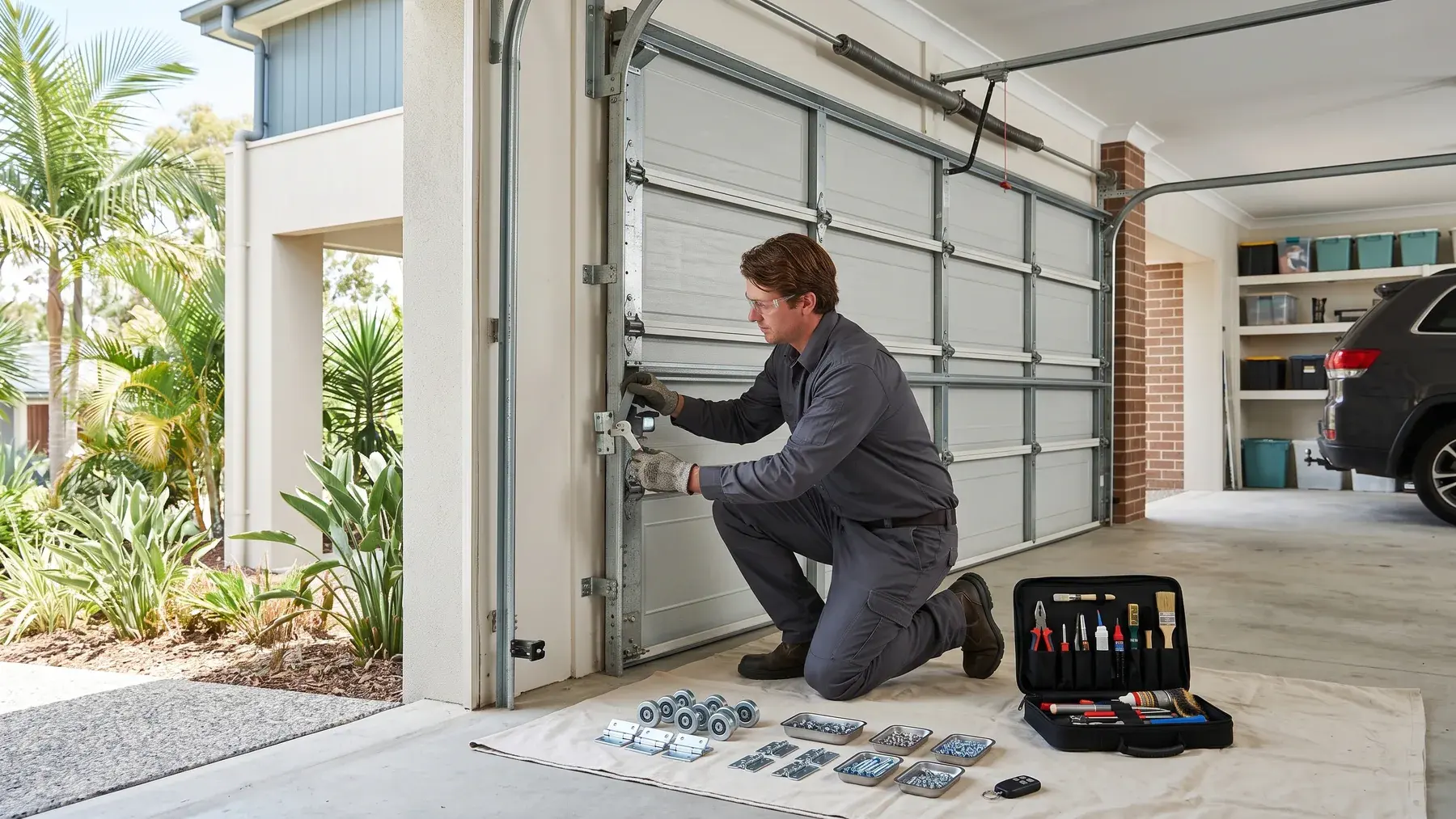
What a service is, and what it is not
A garage door service is an inspection with adjustment. It reports the current condition of the door, corrects the small things that can be corrected on the visit, and identifies what needs replacing.
It is not a repair contract, and it is not insurance against failure. A service cannot stop a counterbalance spring reaching the end of its rated cycle life, and any provider implying otherwise is overselling. What it can do is find the things that fail avoidably — a dragging roller, a fraying cable, a loose bracket, a balance that has drifted, an opener force setting somebody wound up years ago.
Before booking, ask what the service includes and what is charged separately. Definitions vary between providers.
The door: what gets checked
Balance
The most informative single test on any door. With the opener disconnected, a correctly balanced door raised to about waist height should stay roughly where it is. A door that creeps upward is over-sprung; one that drops is under-sprung or has a tiring counterbalance.
Balance drift is the earliest warning of counterbalance wear, and it typically appears weeks or months before a failure. It is the reason a service on a working door is worth booking at all.
Springs and shaft
Visual inspection for pitting, gapping, correct wind and shaft alignment; end and centre bearings checked for wear and noise. Nothing here is adjusted casually — spring work is a repair, not a maintenance item.
Lifting cables and drums
Inspected along their full length for fraying, kinking, corrosion and correct seating in the drum grooves. Drum settings are checked so both sides of the door lift together.
This is the check you cannot do properly yourself, and it is the one most likely to find something. A cable with a few broken strands near the bottom bracket looks like nothing from six feet away.
Rollers and hinges
Every roller checked for free rotation, flat spots, stem condition and bearing noise. Hinges checked for cracking, elongated fixing holes and correct numbering and position across the door.
Tracks and brackets
Tracks sighted for alignment, kinks and correct spacing from the door. Track brackets and mounting hardware checked for tightness — fasteners work loose over thousands of cycles and with normal building movement.
Panels, curtain and seals
Sections checked for creasing, delamination and corrosion, with particular attention to the bottom section. On a roller door, the curtain is checked for bowing and the guides for debris and alignment. Bottom and perimeter seals checked for perishing.
Lubrication
Applied where the manufacturer specifies, in the way they specify — and deliberately not applied where they say not to. Tracks in particular are usually kept clean rather than lubricated, because grease collects grit and wears rollers faster.
The opener: what gets checked
Travel limits
Where the opener believes fully open and fully closed are. Limits drift, and a door that stops short of the floor lets water, dust and vermin in.
Force settings
How much resistance the opener will push against before deciding something is in the way. A force setting higher than it needs to be is a red flag: it usually means somebody was compensating for a mechanical problem.
Safety beams
Photo-eye alignment, lens condition and correct indication. This is also where a lot of “the door will not close” calls are quietly resolved.
The safety reversal test
This is the one that matters most and gets done least.
An automated door should stop and reverse when it meets resistance while closing. Your opener’s manual sets out the manufacturer’s test method for your specific model — commonly involving an obstruction of a specified height placed in the door’s path.
If your door does not reverse reliably, stop using the automation until it has been looked at. It is the difference between a door that stops when it meets something and one that keeps going.
Drive and trolley
Belt, chain, screw or direct-drive components checked for wear, tension and noise; the trolley and manual release checked for correct operation.
Controls
Wall button, every remote, any keypad, and the receiver. Remote batteries are a routine replacement item.
What is included versus what is quoted separately
Generally included in a service:
- the full inspection above;
- tightening fasteners;
- minor alignment correction;
- lubrication to the manufacturer’s schedule;
- opener limit, force and safety checks;
- a plain description of what was found.
Generally quoted separately:
- replacement rollers, hinges, cables, seals or springs;
- opener parts;
- panel or section work;
- anything that turns out to be a repair rather than an adjustment.
Ask whether you get a written summary of findings. On a rental or managed property it is worth having.
What a first service typically finds
If a door has never been formally inspected, expect a list rather than a single item. That is normal, not alarming. The common findings are:
- a dry or seizing roller;
- a loose track bracket;
- early cable fraying;
- balance drift;
- an opener force setting that has been increased;
- perished bottom seal;
- corrosion at hinges and fixings, in coastal positions.
Individually none of those is dramatic. Together they explain why the door has been getting gradually worse.
How often
Follow the schedule in your door and opener documentation. It is specific to the product and can affect warranty conditions.
The two factors that shorten the interval in practice are usage and exposure. A door cycling six to eight times a day as the household’s main entry accumulates wear far faster than one used twice a week. A door in a directly exposed coastal position — manufacturers publish specific coastal care guidance for seaside suburbs — needs attention more often than one a few kilometres inland.
What you can do between services
- Keep the bottom of both tracks or guides clear of debris and stored items.
- Wipe the photo-eye lenses and keep the beam path clear.
- In an exposed coastal position, wash the door and hardware down with fresh water as your manufacturer specifies.
- Listen for new noises and note where in the travel they occur.
- Notice if the door starts feeling heavier by hand.
And the standing exclusions: do not adjust springs, do not adjust force settings to work around a problem, do not grease the tracks, and do not disable the safety beams for any reason.