First, the two situations are different
People use “stuck” for both, but they need different responses.
Stuck open is primarily a security problem. The mechanism has stopped, the opening cannot be closed, and the contents of the garage — and often an internal door into the house — are exposed. The door itself may be perfectly stable.
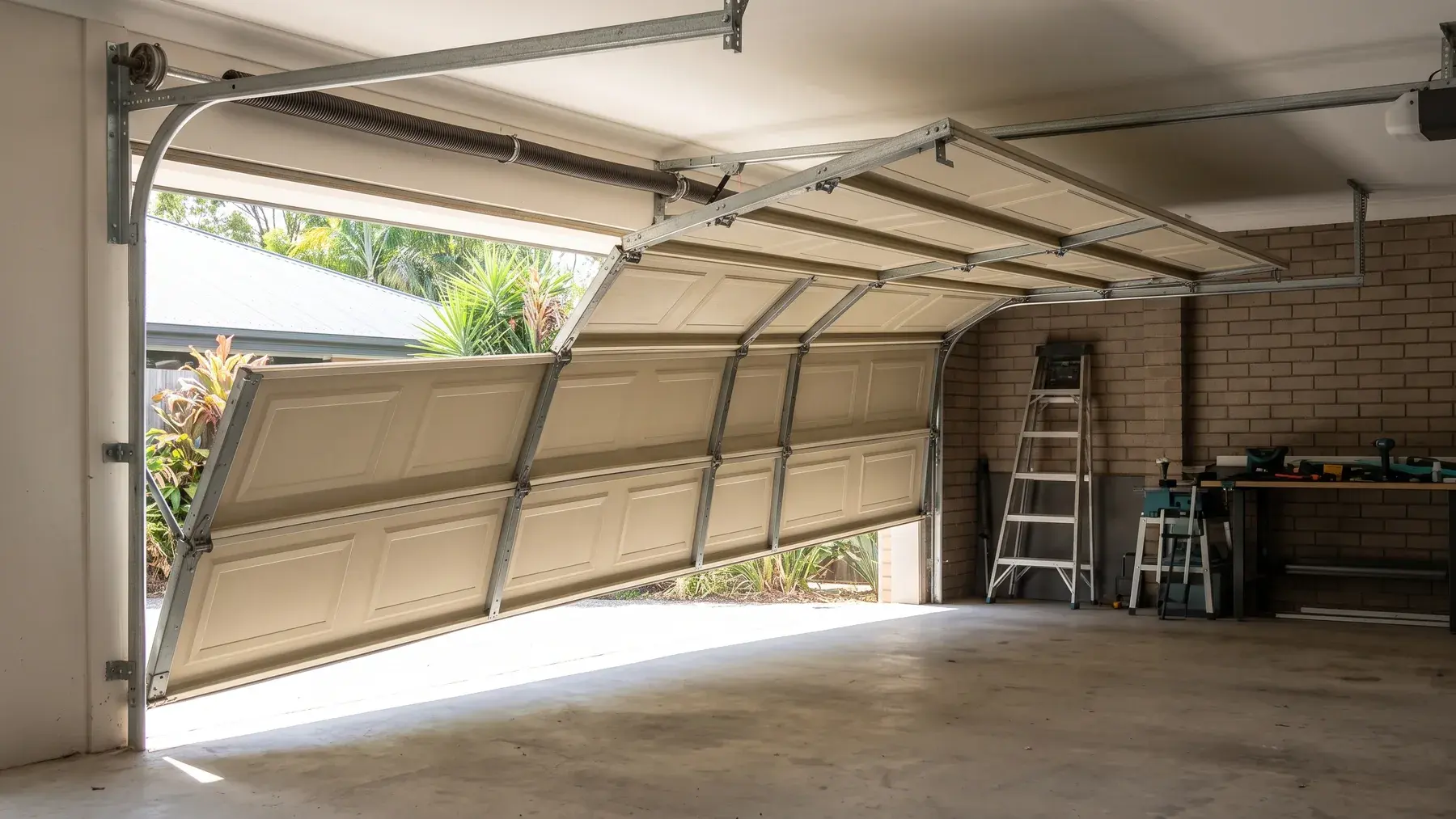
Off track is primarily a safety problem. Rollers have left the track, or a cable has failed, and the door is being supported in a way it was not designed for. It may look still. It is not necessarily stable.
Some doors manage to be both. Work through the safety question first.
The first ten minutes
If the door is off track, crooked, or sitting unevenly
- Stop operating it. Do not press the button again to see whether it will go this time. Every attempt tends to bend the track further, break a roller off its stem, or damage a panel.
- Clear the area beneath and beside the door. Move vehicles, bicycles, bins and anything you would not want under a door that moves. Do this without walking under the door.
- Keep children and pets out of the garage entirely until it has been assessed.
- Do not prop it. A ladder, a length of timber or a vehicle jack under a partly open door is not a support; it is a second thing to fail.
- Note what you saw and heard. A bang, a grind, a jolt, and roughly when.
If the door is stuck open but sitting square
- Secure the internal door between the garage and the house. That is usually the highest-value thing you can do in the first five minutes.
- Move anything valuable out of the garage, or out of easy reach from the opening.
- Check the obvious opener causes before assuming the worst: is anything sitting in the safety-beam path near the floor? Are the photo-eye lenses dirty? Has the circuit tripped?
- If a vehicle is inside and you need it, ask about the manual release when you call rather than experimenting with a door you are unsure about.
What not to do, and why
Do not try to lift a jammed door back into position. An off-track door has usually left the track because the load path changed — a cable failed, a roller seized, a track bent. Lifting it back in without releasing and resetting that load commonly makes the situation worse and can let the door drop.
Do not loosen anything. The bottom brackets at the base of a sectional door remain under cable tension whenever the door is closed. Springs above the opening hold a large amount of stored energy. Neither is a homeowner-serviceable component.
Do not force a roller door curtain back into its guide. The curtain edge is thin steel and the guide distorts easily. Forcing it is the most reliable way to turn a repair into a curtain replacement.
Do not increase the opener’s force setting to push the door through a bind. That removes the protection that stops the door on an obstruction, and it hides the mechanical cause.
Working out roughly what happened
You do not need a diagnosis, but a rough category makes the call much shorter.
| What you can see | Usually points at |
|---|---|
| One side of the door noticeably lower than the other | A lifting cable or drum problem |
| A visible gap in a coiled spring above the door | A counterbalance spring failure |
| A roller clearly out of the track, door wedged at an angle | Running gear, often after a bind or an impact |
| A kink or bow in a track section | Impact, a loose bracket, or repeated operation through an obstruction |
| Door open, motor clicking, nothing moving | Opener-side: drive, trolley or a disengaged release |
| Door open, nothing at all happening | Power, control or receiver |
| Roller curtain jammed, edge clear of one guide | The curtain has left its guide |
If none of those match, that is fine. Describing the behaviour is enough.
If you need the car out
A manual release exists precisely so a door can be operated when the opener cannot. It disconnects the door from the drive.
What it does not do is restore the counterbalance. If the springs are intact and the door is simply not being driven, releasing it and lifting by hand is usually straightforward. If a spring has failed, the door is unbalanced and can be extremely heavy or can drop.
So: if you heard a bang, if the door already felt heavy, or if you can see a broken spring, ask before you pull the cord. Describe what you can see and take the advice given.
Photographs, if an insurer might be involved
If the damage came from an impact or a storm, photograph the door before anything is moved. Get the overall view of the door in the opening, and then closer images of the damage, the tracks and anything that has come away.
It costs two minutes and it removes an argument later. Mention on the call whether you intend to claim, because it can change what documentation a provider records.
What to tell whoever you ring
- The door’s current position: fully open, fully closed, or stuck part-way — and whether it is level.
- What you heard when it failed, and when.
- Whether anything is trapped inside.
- What you can see: a broken spring, a slack or hanging cable, a roller out of its track, a dent.
- Whether the property can be secured another way.
- The door type: roller curtain, or sectional with hinged panels.
- Your suburb, and how much space there is in front of the door for a vehicle and a ladder.
And one honest note about timing
Nobody can promise you an arrival time on a website. Availability depends on who is free, how far away they are and what else is on their day. If you have a door stuck open and the property cannot be secured, treat the security problem as yours to manage in the meantime — lock the internal door, move what matters, and make other arrangements if nothing can be confirmed.
That is a less satisfying answer than “someone will be there within the hour”. It is a more useful one.