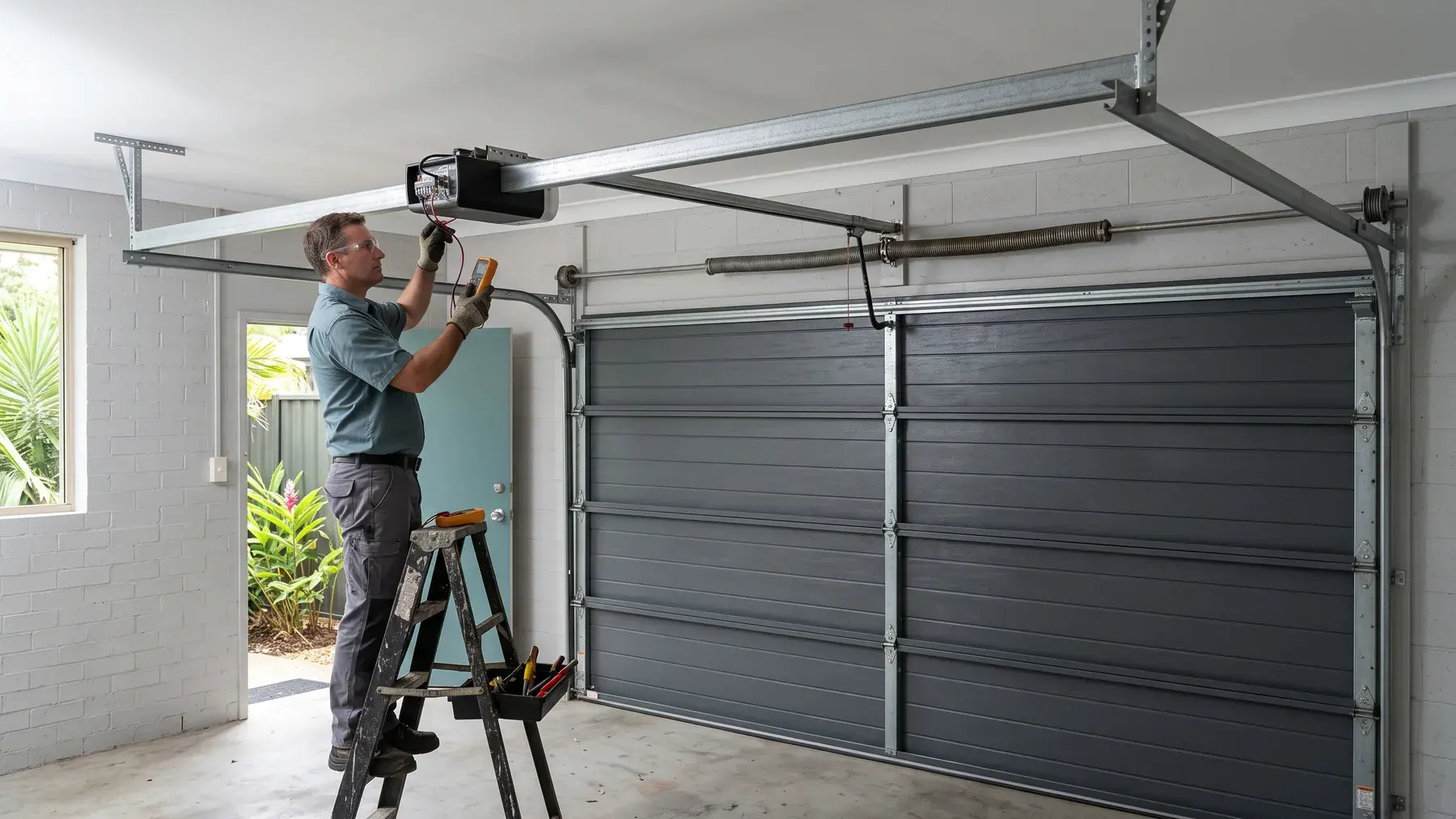
The short answer
If the motor makes its usual noise but the door does not move, or moves and stops, the problem is more often mechanical than electrical. If nothing happens at all — no sound, no light, no response from any control — the problem is more often electrical or control-side.
That is a starting point, not a diagnosis. The reason it holds up is a piece of mechanics worth understanding before you touch anything.
The opener does not lift the door
This is the single most useful fact in this whole article.
A residential garage door is heavy. A double sectional door can weigh well over a hundred kilograms. The motor bolted to your garage ceiling is not lifting that. The counterbalance springs are.
Those springs are wound or stretched so that they offset almost the entire weight of the door. A correctly balanced door, disconnected from the opener, can be moved by hand with modest effort and will roughly hold its position when you let go. The opener’s job is to supply the small remaining push and pull, and to hold the door where the limits tell it to stop.
Once you know that, a lot of confusing symptoms resolve:
- A motor that sounds completely healthy but cannot shift the door is usually reporting a mechanical problem, not having one.
- An opener that strains, groans and gives up is usually being asked to do work the springs are no longer doing.
- A door that moves fine by hand but ignores every remote almost certainly has a control, power or safety-beam fault.
What each failure sounds and looks like
Signs that point at the counterbalance
- You heard a bang. Often loud enough to be heard inside the house, frequently when nobody was operating the door. This is the classic spring-failure sound.
- The door is suddenly extremely heavy by hand. Not stiff, not sticky — heavy in a way that feels wrong.
- You can see a gap in a coiled spring above the door. On a sectional door the torsion springs sit on a shaft above the opening. A break leaves a visible gap between the coil ends.
- The door lifts a few centimetres, then drops back, with the opener straining.
- The door sits crooked, one side higher than the other, which usually means a cable or drum has been affected too.
On a roller door there is nothing to see, because the spring assembly is inside the barrel. There the signs are behavioural: the curtain drops faster than it should, will not stay up, or has become far heavier than it was.
Signs that point at the opener
- Nothing at all happens. No motor sound, no light, no response from the wall control. Check the circuit breaker and that the unit is plugged in before anything else.
- The motor runs but the door does not move. On a rail-driven opener, watch the trolley: if it travels along the rail without the door following, the connection between them has failed — a stripped drive gear, a failed trolley, or a manual release left disengaged.
- The door opens but will not close. This asymmetry is characteristic of the safety beams. Most openers permit opening with a broken beam but refuse to close.
- Only one remote has stopped working. That is a handset or battery issue, not a system failure.
- The door reverses just before it closes. Usually travel limits, force settings, or something the door is meeting at the floor.
The test that settles it — with one condition
If the door is closed, and you have no reason to suspect a spring failure, you can separate the two directly:
- Make sure the door is fully closed and nothing is under it.
- Pull the manual release cord to disconnect the door from the opener.
- Lift the door by hand, slowly, to about waist height.
- Let go.
A balanced door feels manageable and stays roughly where you left it. That points at the opener.
A door that is heavy, jerky, uneven, or that drops or shoots up has a mechanical problem. That points at the counterbalance.
The condition, stated plainly
Do not do this if you heard a bang, if the door already feels heavy, or if you can see a gap in the spring. The manual release disconnects the opener; it does not restore the counterbalance. On a door with a failed spring, pulling that cord can leave you holding the full weight of the door, or leave the door free to drop.
If you are in any doubt, skip the test. It is a convenience, not a requirement, and describing what you observed from a safe distance is enough for a useful phone call.
Checks that are genuinely safe to make
None of these bring you near a loaded component:
- Wipe both safety-eye lenses with a dry cloth and clear anything in the beam path. Bins, bikes, boxes and cobwebs are all common. Note whether the small indicator LEDs are steady, flashing or off.
- Test every control — the wall button, each remote, and any keypad. Note precisely which work and which do not.
- Change a suspect remote battery before assuming the receiver has failed.
- Check the circuit breaker and that the opener is plugged in.
- Watch one full cycle from a safe distance and note exactly where the door stops, hesitates or reverses.
- Look at the door from the ground: is it sitting level in the opening? Is either lifting cable slack, looped or visibly frayed?
Where the line is
There is one adjustment people reach for that they should not: turning up the force setting so the door will move.
Force limits exist so the opener stops when it meets resistance. Winding them up to overcome a heavy or binding door does two bad things at once. It removes the protection that stops a closing door on an obstruction, and it hides a mechanical fault that will keep getting worse. If a door needs more force than it used to, that is information, not a problem to configure away.
Similarly: springs, cables, drums and the bottom brackets are not homeowner-serviceable. The bottom brackets stay under cable tension whenever the door is closed. There is no adjustment there worth the risk.
What to say when you call
Whatever you have worked out, the description is what matters:
- what the motor does — silent, humming, running without moving the door, or running then reversing;
- which controls fail and which still work;
- whether you heard a bang, and roughly when;
- whether the door sits level, and whether anything is visibly out of place;
- whether the door moves freely by hand, if you were able to check that safely;
- the opener brand from the housing label, read from the ground;
- your suburb, and whether a vehicle is trapped inside.
That is enough for a provider to know what to bring. It is also enough to avoid the most annoying outcome — someone attending for an opener fault and finding a spring problem, or the reverse.
Verifying who does the work
Licence requirements depend on the actual scope of work rather than on the trade name, so if any part of the job involves fixed electrical work it is worth asking the provider directly what their scope covers. In Queensland the QBCC maintains a public register of licensed contractors, which is the place to check a licence rather than taking a claim at face value.